Heads up: some links here are affiliate links. If you buy through one, we may earn a commission; your price stays the same. Details
Pianoforall: A self-paced online piano course that starts with chords and rhythm, with video lessons and downloadable ebooks, for one $49 payment.
Try or buy Pianoforall on the official site60-day money-back guarantee
In this guide (9 sections)
- Can I really learn piano by myself?
- What do I need to set up before the first lesson?
- What order should I learn things in?
- How long does it take to teach yourself piano?
- What does a manageable weekly practice routine look like?
- Why do piano students quit, and how do I spot when self-study is not working?
- Is a structured online course worth it for self-study?
- Your home-study piano checklist
- How does this fit with learning piano as an adult?
Can I really learn piano by myself?
Yes, plenty of adults learn piano by themselves, and what matters most is a clear order of steps and steady practice.
Self-study has real limits. Nobody is watching your hands, so you need ways to check your own playing. The plan below builds those checks in.
Do you need a high IQ or natural talent?
No, you don’t need a high IQ or special talent to learn piano. The instrument rewards repetition and good sequencing, much like learning a route by walking it again and again.
What helps more is a plan you can keep. If you’ve played before, expect the early steps to feel familiar.
Self-study, free videos or a teacher: how to choose
Self-study suits you if you can follow a plan and check your own playing; add a teacher if you can’t hear your mistakes or tension builds.
Free lessons and video lessons are a good start. They can leave gaps in order, though, because each video stands alone. Our guide to free piano lessons for adult beginners covers those gaps, and the best way to learn piano page compares your options.
Decision rule: Stay self-taught while you improve month to month. Switch method if you stall for three or four weeks. Book a single teacher check-in if you suspect bad habits or feel tension in your hands.
What do I need to set up before the first lesson?
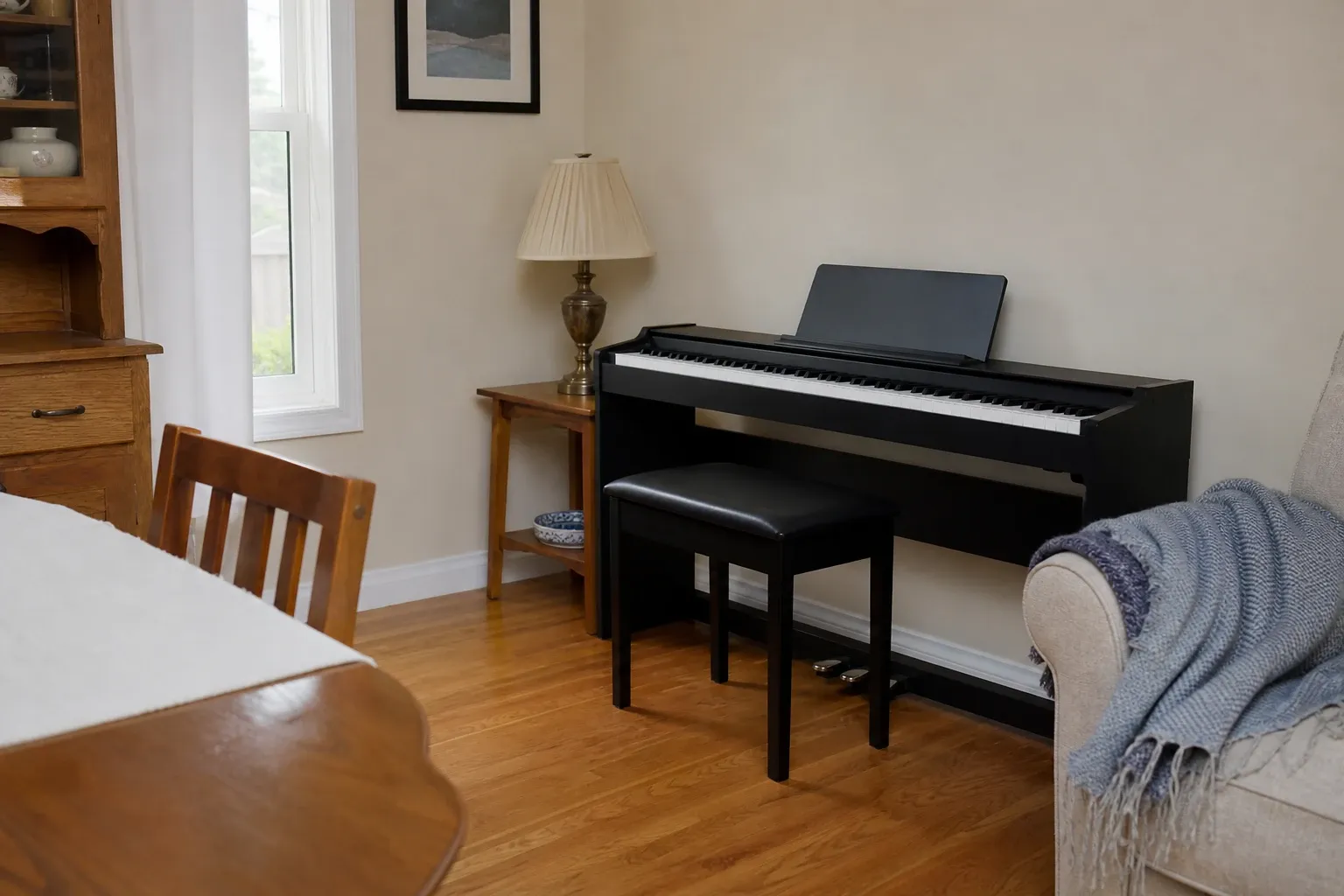
You need a keyboard or piano, a stable seat, a music stand and a quiet slot in your day. That’s it; keep it simple.
Keyboard or piano, stand and bench
An 88-key keyboard (the full piano range) is ideal, and weighted keys, which feel like a real piano, are helpful but not required. A MIDI keyboard (one that sends notes to a computer or app instead of making its own sound) also works with learning apps.
For your seat, use a bench or stable chair at a height where your forearms are roughly level with the keys. Put the music or screen where you can see it without craning.
For reference, the maker of Pianoforall says its course needs at least 61 full-size touch-sensitive keys and a sustain pedal.
Learning without owning a piano
You can begin without a piano using a borrowed keyboard, a practice room or an on-screen keyboard app. The limit is that a screen has no touch, so you can’t build finger strength or feel for the keys.
Treat an app as a way to learn note names and the layout. Move to a real keyboard when you can.
Tuning: how often a piano needs it
Acoustic pianos are typically tuned about once or twice a year, while keyboards never need tuning. If you have an acoustic piano, ask a tuner how often yours needs it.
Quick tip: Put your keyboard where you’ll see it daily. A keyboard in a cupboard is a keyboard you won’t play.
What order should I learn things in?
Learn in this order: keyboard layout and hand placement, first melodies, scales, chords, then rhythm, reading basics and playing by ear. Each step gives you something to build on.
Step 1: Keyboard layout and hand placement
Keyboard layout is the pattern of black keys in groups of two and three, and it’s how you find every note. Find the group of two black keys; the white key just left of them is C.
For hand placement, rest relaxed, gently curved fingers on the keys, thumbs on their sides. Our piano key and note layout page maps it out. By the end of this step you can name any white key quickly.
Step 2: First notes and simple melodies
First melodies are short tunes played with one hand using five notes. Try C D E F G up and back down, then a tune you know.
This step trains your fingers to move one at a time. Expect it to feel slow; that’s normal. See easy piano songs for beginners for ideas.
Step 3: Scales, keys and the F major scale
A scale is a set of notes climbing in a fixed pattern, and a key is the scale a song is built on. Start with C major (all white keys), then F major, which uses one black key, B flat.
The F major scale is F G A Bb C D E F. A common right-hand fingering is 1 2 3 4 1 2 3 4, with 1 as the thumb. Our scale practice routine has more.
Step 4: Chords and chord progressions
A chord is three or more notes played together, and a progression is a chord sequence. Build major chords on your scales: C major (C E G), F major (F A C) and B flat major (Bb D F).
Play C, F, C, then hold each chord for four slow beats. With these you can accompany many songs. Try easy piano chords and chord progressions next.
Step 5: Rhythm, reading basics and playing by ear
Rhythm is how long each note lasts, and playing by ear means finding a tune without written music. Learn note values, the time signature (the numbers showing beats per bar) and how to read notes.
For ear training, hum a simple tune and hunt for it on the keys. Our guides on playing by ear and reading sheet music help. You need just enough music theory to play what you want.
How long does it take to teach yourself piano?
Timelines vary a lot from one person to the next. As a rough guide, simple songs may take weeks to a few months, comfortable chord playing a few months, and fluent playing years.
Three things shape your pace: practice minutes, consistency and any earlier music experience. A returner often moves faster than a first-timer.
| Checkpoint | What to look for |
|---|---|
| 4 weeks | You know the keyboard layout, sit comfortably and play a short one-hand tune |
| 12 weeks | You play C and F major scales slowly and a few major chords, and can accompany a simple song |
| 26 weeks | You play a few full songs with chords, keep a steady beat and find simple tunes by ear |
These are our own guideposts, not research findings. If you’re well behind at a checkpoint, change something in your routine rather than giving up. Our page on how hard piano is to learn sets expectations.
Check the current Pianoforall course, price and trial billing terms on the vendor’s site if you’d like a ready-made order.
Try or buy Pianoforall on the official site60-day money-back guarantee
What does a manageable weekly practice routine look like?
A manageable routine is about 25 minutes, five days a week, with a written plan before you sit down. Short and regular beats long and rare.
A 25-minute daily session
Split the time into four parts: 5 minutes of warm-up, 10 on new material, 5 on review and 5 playing for fun.
Example warm-up: play the F major scale hands separately, slowly, twice. Write the plan on a sticky note first.
The 80/20 rule for piano practice
The 80/20 rule here means spending most of your time on the hardest 20 percent of a piece. Find the one bar that trips you up and loop it slowly.
Playing the whole song again feels good but fixes little. This is common teaching advice rather than a research result.
A sample week
| Day | Focus |
|---|---|
| Mon | Scale, new chord, review |
| Tue | Melody, hard bars slowly |
| Wed | Rest or play for fun |
| Thu | Chords in a progression |
| Fri | Ear training, a tune by ear |
| Sat | Review and play a song |
| Sun | Rest |
Our piano practice routine for beginners page expands on this.
Why do piano students quit, and how do I spot when self-study is not working?
Students usually quit because they have no clear next step, the material bores them or the basics were skipped. Pain or tension is another reason.
Warning signs
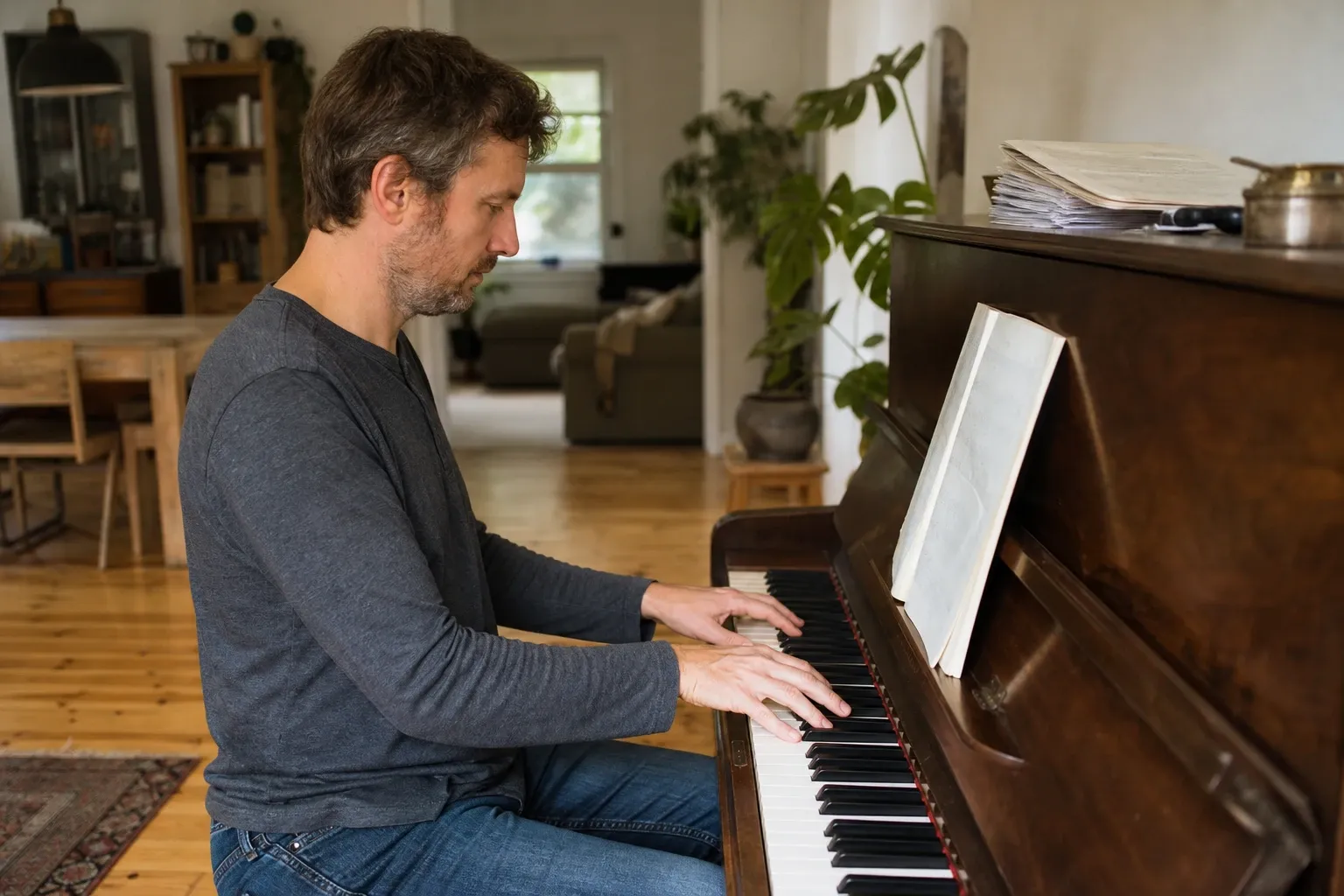
Watch for the same piece for weeks with no improvement, avoiding the keyboard, or habits you can’t hear yourself. Tension in your shoulders or hands is another flag.
Quick tip: Record yourself on your phone once a week. Playback shows uneven beats you miss while playing.
What to change
Shrink the goal, slow the tempo and pick songs you like. Try a structured course, or book one teacher check-in to look at your hands.
If your hands hurt, stop and rest. For ongoing pain, ask a health professional.
Is a structured online course worth it for self-study?
A structured online course is worth it if you want a ready-made order and don’t want to piece free lessons together. It’s less useful if you already have a plan or prefer a live teacher.
What to look for in a course
Look for a clear order, video you can replay, chords and ear training, downloadable material and a way to review. Also check whether it offers individual feedback, since a self-paced course usually doesn’t watch your playing.
Pianoforall is one example. The maker describes video lessons plus ebooks covering rhythm-style playing, chords, blues, jazz and classical. It’s a one-time payment of $49 for the complete course, with no subscription.
Our button opens its 7-day trial page, where you can buy outright or start the trial (the trial needs payment details and charges $49 when it ends unless you cancel). Our Pianoforall review goes deeper.
You may prefer free lessons or a teacher if you like live feedback or have a tight budget. See cheapest ways to learn piano.
Try or buy Pianoforall on the official site60-day money-back guarantee
Your home-study piano checklist
This checklist covers setup, your first week, your first month and troubleshooting.
Print it and tick items off as you go. Revisit the troubleshooting items whenever you feel stuck.
How does this fit with learning piano as an adult?
Teaching yourself at home is one route within the wider picture in Learning Piano as an Adult: A Practical Overview. That page helps you weigh goals, time and budget.
If you’re wondering how hard it gets, read how hard it is to learn piano as an adult. For a deeper routine, see piano practice routine for beginners.
Your next step is small: choose your 25-minute slot for tomorrow and write down what you’ll play.
Common questions
- Should I learn to read music first or chords first?
Either works. Chords first lets you play real songs sooner and keeps motivation up, while reading first suits classical goals. Many learners do both slowly together: a few chords each week plus a little note reading in the right hand.
- Is it better to learn piano from a teacher or yourself?
Neither is better for everyone. A teacher can correct technique and keep you accountable, which suits exams and classical study. Self-study costs less and fits your schedule, which suits chords and songs. Many adults mix both with occasional check-in lessons.
- Am I too old to teach myself piano at 40 or later?
No. Adults of any age can learn piano. Adults often bring patience and focus but have less free time, so short, regular sessions matter more than your age. Start with a few chords and one simple song, and build from there.