Heads up: some links here are affiliate links. If you buy through one, we may earn a commission; your price stays the same. Details
Pianoforall: A self-paced online piano course that starts with chords and rhythm, with video lessons and downloadable ebooks, for one $49 payment.
Try or buy Pianoforall on the official site60-day money-back guarantee
In this guide (10 sections)
- Can I teach myself piano as an adult?
- Step 1: Set up your keyboard, seat and posture
- Step 2: Learn the keys and find your way around
- Step 3: Place your hands and play your first chord
- Step 4: Pick your first song and try playing by ear
- Step 5: Choose how you will learn: teacher, online course, apps or YouTube
- How much should I practise, and what is the 80/20 rule?
- Why do adults quit piano, and how do you keep going?
- Your first-week piano checklist
- Where to go next
Can I teach myself piano as an adult?
Yes, many adults start on their own, and a clear order of steps matters more than which format you pick.
Be realistic about timing. Simple tunes and a few chords can come within weeks of steady practice for many people, but fluency takes much longer, and no timeline is guaranteed.
The first steps are simple. Coordination, meaning getting both hands and your ears working together, takes repetition. For more on the self-study path, see our guide to teaching yourself how to play the piano.
What self-study does well
Self-study lets you fit piano around your life. You choose the time, repeat a tricky bar as often as you like, and pick songs you actually enjoy.
Example: Play the same four-note phrase ten times at a slow pace, then stop. No one is waiting for you, so slow is fine.
Where a guide or teacher helps
A piano teacher helps most when you want someone to watch your hands and correct habits as they form. A self-paced course or video can’t do that, because nobody sees you play.
If you have any pain or discomfort when playing, ask a qualified professional rather than relying on a web page.
Step 1: Set up your keyboard, seat and posture
Any keyboard or piano you already have is enough to begin, and this page doesn’t cover buying one.
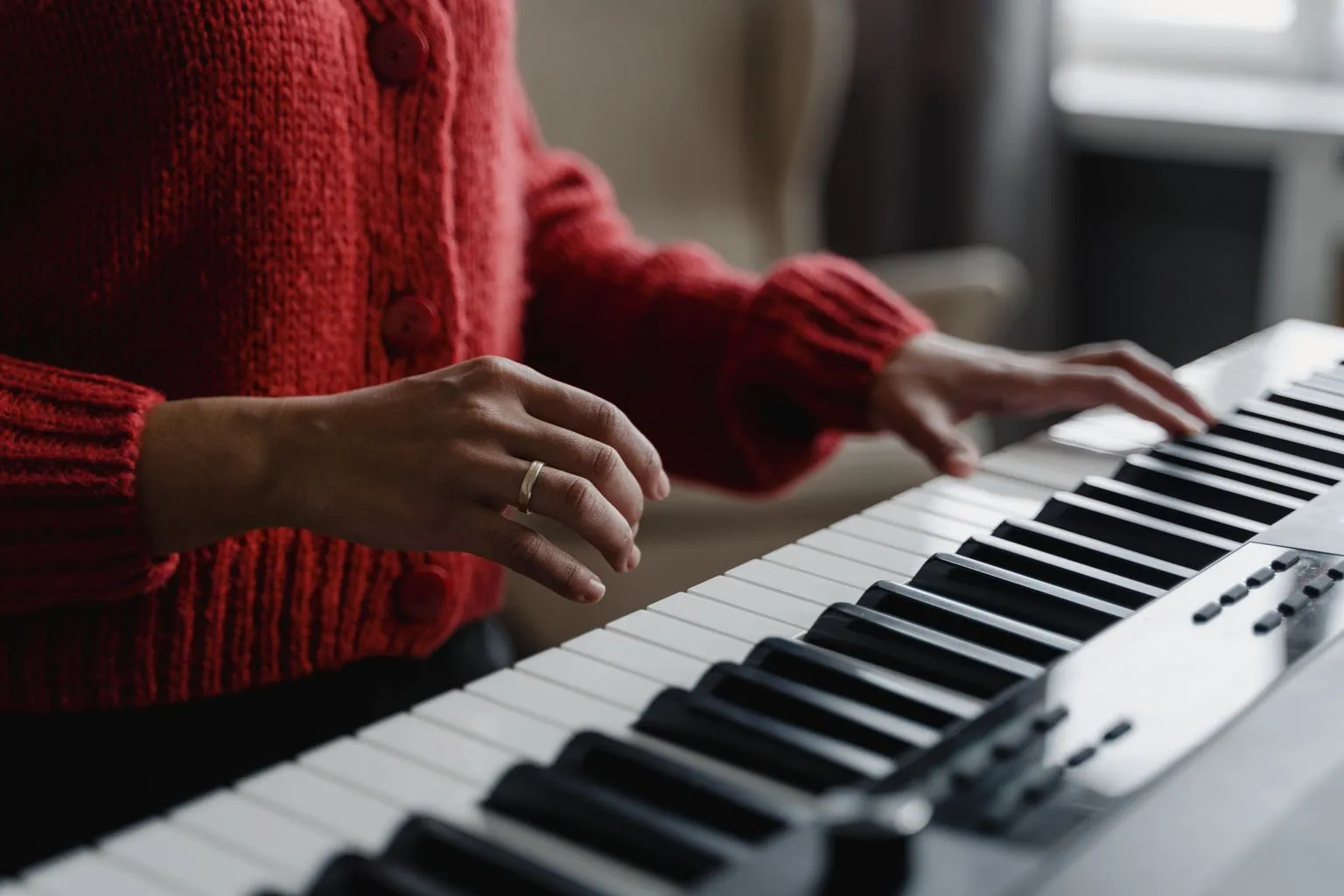
Sit so your forearms are roughly level with the keys, with feet flat on the floor. Keep your wrists relaxed and your fingers gently curved, as if you were holding a small ball.
Pick a quiet spot with few distractions, and choose a regular time, such as right after breakfast. A fixed time does more than motivation does on a tired day.
No piano yet?
You can learn the layout without an instrument. Print a paper keyboard or use a free on-screen one to practise finding notes, then move to real keys when you can.
Paper keys can’t teach touch or sound, so treat this as a stopgap for the layout only.
Quick tip: Put a small note on your music stand with your practice time. It’s a cue, not a rule.
Step 2: Learn the keys and find your way around
A piano’s pattern repeats every 12 keys: 7 white and 5 black. Once you see it, the whole keyboard makes sense.
For a full note-name map, see our piano key note layout page.
The 12 keys and the black-key groups
The black keys come in alternating groups of two and three. These groups are your landmarks, like street signs on a long road.
Finding C and middle C
C is the white key just left of any two-black-key group. Middle C is the one nearest the centre of your keyboard.
From C, the white keys run C, D, E, F, G, A, B, then C again.
Example: Find every C on your keyboard, saying the name aloud each time.
Octaves
An octave is the distance from one note to the next note with the same name, such as C up to the next C. They sound like the same note, only higher or lower.
That repeating pattern is also why scales and chords look the same in every octave.
Step 3: Place your hands and play your first chord
A chord is three or more notes played together, and your first one, C major, uses just three white keys.
Chords come early because they let you accompany songs and begin playing by ear. For more, see our page on easy piano chords for beginners.
Five-finger position
Fingers are numbered 1 to 5, thumb to little finger. Rest your right hand with thumb on middle C, and each finger on the next white key up: C, D, E, F, G.
Keep the hand relaxed and rounded, not stretched flat.
Your first C major chord
Play C, E and G together with fingers 1, 3 and 5. Press, hold for four slow counts, then release.
Example: Play the chord on counts 1 and 3 of a steady count of four, for one minute.
Switching to a second chord
Try F major (F, A, C) or G major (G, B, D) next. Move your whole hand together rather than one finger at a time.
Alternate C then G, four counts each. Many simple songs lean on these chords.
So what should a beginner learn first? The keyboard layout, a relaxed hand shape, and two or three chords.
Step 4: Pick your first song and try playing by ear
The best first song is slow and built on two or three chords, or a simple melody such as Ode to Joy or Twinkle Twinkle.
Slow songs give you time to change hands without panic, and a short melody gives you an early win. Our list of easy piano songs has more ideas.
Yes, you can learn piano by ear with practice. Ear training starts by matching a tune note by note: hum a line, then hunt for the first note until it sounds right.
Example: For Twinkle Twinkle, find the first note by trial, then play it twice, then step up to the fifth note. Check each by ear.
Sheet music, lead sheets (a tune with chord names above it) and theory can arrive gradually. You don’t need to read music on day one, though it helps later. See how to read sheet music for piano when you’re ready.
Step 5: Choose how you will learn: teacher, online course, apps or YouTube
Pick one method and stay with it for the first few weeks, because switching often costs more time than any method’s weakness.
Prices vary by region and provider, so the table describes cost in general terms only.
| Method | Cost (general) | Structure | Feedback on your playing | Best for |
|---|---|---|---|---|
| Piano teacher | Usually the highest, paid per lesson | Set by the teacher | Yes, live | People who want correction |
| Structured online course | Often a one-off or subscription fee | Planned order | Usually none individual | Order plus flexibility |
| Piano apps | Often free tier plus paid plans | Guided levels | Some apps listen, varies | Short daily sessions |
| Free YouTube videos | Free | Mixed, you assemble it | None | Trying piano first |
Simple rule: if you need feedback, pick a teacher. If you want order and flexibility, pick a structured course. If you want to try first, start with free videos.
Piano teacher
A teacher can spot habits you can’t see yourself. The trade-off is cost and fixed times.
Structured online course
A course gives you a set order so you aren’t guessing what comes next. Check what’s included and how billing works before paying.
Pianoforall is one self-paced option. The maker says it offers video lessons and downloadable ebooks on rhythm-style playing, chords, blues, jazz and classical. The vendor lists a starting setup of at least 61 full-size touch-sensitive keys and a sustain pedal.
It costs $49 once for the complete course, with no subscription. It doesn’t watch you play, so it won’t replace feedback from a teacher. Our button opens its 7-day trial page, where you can buy outright or start the trial (the trial needs payment details and charges $49 when it ends unless you cancel).
Piano apps
Apps suit short sessions and can feel game-like. Check whether the app listens to your playing, as features differ.
Free YouTube videos
YouTube costs nothing and is good for a taste of piano. The catch is that you must build your own order. See our page on free piano lessons for adult beginners.
See what’s in the course and how the trial works. We may earn a commission if you buy through our link, at no extra cost to you.
Try or buy Pianoforall on the official site60-day money-back guarantee
How much should I practise, and what is the 80/20 rule?
A beginner can practise 15 to 20 minutes most days, and short regular sessions beat rare long ones.
The 80/20 rule is a loose rule of thumb, not a measurement: most of your progress comes from a small part of your practice. In piano, that means the few hard spots and core skills. For a fuller plan, see our piano practice routine for beginners.
A realistic weekly schedule
A weekly schedule of 15 to 20 minutes on five days gives you about 75 to 100 minutes. Three 30-minute sessions work too, if that fits your week.
| Plan | Time | Total per week |
|---|---|---|
| Short daily | 15 min x 5 days | 75 min |
| Longer, fewer | 30 min x 3 days | 90 min |
Applying 80/20 to practice
Spend most of your time on chords, rhythm and the one song you’re learning, not on everything at once. Loop the two bars that trip you up instead of replaying the whole piece.
Example: Switch between C and G chords for five minutes, then play the song once through.
Track a weekly goal, such as “play the first line cleanly,” rather than demanding daily perfection. Scales can wait until chords feel comfortable; see our piano scale practice routine.
Why do adults quit piano, and how do you keep going?
Adults most often quit piano because they have no clear plan, start with pieces that are too hard, practise irregularly, or see no early wins.
These are common-sense reasons rather than study findings.
Fixes are small. Set tiny goals, play songs you like, keep a set time, and record yourself once a week so you can hear change.
Example: Record the C to G chord switch on your phone today, and again in a week.
If you miss a week, don’t start over. Sit down for five minutes, replay the last thing you knew, and go from there. Missing time says nothing about your ability.
Your first-week piano checklist
Your first week needs about 15 to 20 minutes a day, in a set order, with a rest day if you like.
Day 1 to 2
Set up your seat and keyboard, then find every C. Spend 15 minutes on the black-key groups and note names.
Day 3 to 4
Practise the five-finger position, then play C major with fingers 1, 3 and 5. Add G or F major and alternate. Aim for 15 to 20 minutes.
Day 5 to 7
Pick one slow song and try its first line by ear. Choose your learning method for the next few weeks, then plan the same time slot for week two.
By the end of week one, you may be able to find your way around the keys and play two chords with a steady beat. That’s a fine start, and everyone moves at their own pace.
Check the current Pianoforall course, price and trial billing terms on the vendor’s site if a self-paced course appeals.
Try or buy Pianoforall on the official site60-day money-back guarantee
Where to go next
This page is the starting line, and the wider plan lives in our Learning Piano as an Adult: A Practical Overview.
If chords caught your interest, try easy piano chords for beginners. To build a steady habit, use the piano practice routine for beginners.
Common questions
- How long should a beginner practise piano each day?
A beginner can aim for 15 to 20 minutes on most days. Short, regular sessions usually work better than one long session a week. If your schedule is tight, even 10 minutes with one clear goal is worth doing.
- Do I need to read sheet music to start?
No. You can begin with the keyboard layout, a few chords and simple tunes played by ear. Reading sheet music helps later, and you can add it gradually once your hands feel comfortable on the keys.
- Is it too late to start piano as an adult?
No, adults can start piano at any age. You may learn differently from a child, with more patience and clearer goals, and you can choose songs you like. Progress varies from person to person, and no result is guaranteed.