Heads up: some links here are affiliate links. If you buy through one, we may earn a commission; your price stays the same. Details
Pianoforall: A self-paced online piano course that starts with chords and rhythm, with video lessons and downloadable ebooks, for one $49 payment.
Try or buy Pianoforall on the official site60-day money-back guarantee
In this guide (8 sections)
- How long should scale practice take each day?
- Step 1: Start with C major and the fingering basics
- The weekly schedule: add one key at a time
- How do I fit scales into a short practice session?
- Common scale mistakes and how to fix them
- Do scales help with chords and playing by ear?
- Scale practice checklist
- Where does this fit in your wider practice?
How long should scale practice take each day?
Scale practice should take about 5 to 10 minutes of a daily session. Scales are a warm-up slice, not the main event.
A scale is a set of notes climbing in a fixed pattern of steps, like a staircase with a set rhythm of big and small steps. Playing one smoothly trains your fingers to find the notes without hunting.
The 10-minute scale slot
A 10-minute scale slot is enough for one new key plus one older key. Short and daily beats long and occasional.
Example: play C major hands separately twice, then together twice, all slowly. Stop when the clock says so, even if you feel like pushing on.
What to expect in the first weeks
In the first weeks, expect scales to feel clumsy, and that’s normal. Slow, even and relaxed playing matters more than speed.
Speed comes later and no one can promise when. Aim for each note sounding the same length and volume as the last.
Step 1: Start with C major and the fingering basics
The C major scale is the best first scale because it uses only white keys, so you can focus on fingering. Fingering means which finger plays which note, numbered 1 (thumb) to 5 (little finger).
If you need to find your notes first, see our piano key note layout guide.
Right hand fingering
Going up from middle C, the right hand plays 1-2-3-1-2-3-4-5. That’s C, D, E with the first three fingers, then thumb on F and on up to the next C.
Left hand fingering
The left hand going up plays 5-4-3-2-1-3-2-1. Start with your little finger on the C below middle C, and your thumb lands on G.
The thumb-under move
The thumb-under move tucks your thumb beneath your hand so the next note follows without a gap. It keeps the sound connected and the hand smooth.
Practise just the crossover: play E, F in the right hand, 3 then 1, ten times slowly. Keep the wrist level instead of twisting it.
Start hands separately, then together at a slow tempo.
The weekly schedule: add one key at a time
A weekly schedule adds one key at a time, ordered by how few sharps and flats each key has. A sharp or flat is a black key that raises or lowers a note; the set a key uses is its key signature.
| Weeks | New key | Also review |
|---|---|---|
| 1 to 2 | C major, then G major | C |
| 3 to 4 | F major, then D major | C, G |
| 5 onward | A minor, then more | One older key |
Each week, learn the new key hands separately, then together, then review one old key.
Week 1 to 2: C major and G major
The G major scale has one sharp, F sharp, and uses the same fingering pattern as C major. Right hand 1-2-3-1-2-3-4-5, left hand 5-4-3-2-1-3-2-1.
Week 3 to 4: D major and F major
The D major scale has two sharps and keeps the same fingering pattern too. The F major scale is the odd one: the right hand plays 1-2-3-4-1-2-3-4, with the 4th finger on B flat.
Later weeks: A minor and other minor scales
The A minor scale is a good first minor, and it’s also white keys only. The natural minor scale is the plain minor pattern with no raised notes, so it sounds darker than major.
Add it once a few major keys feel steady. Fingering is the same as C major.
How do I fit scales into a short practice session?
Fit scales in as a short block at the start, then spend the rest on pieces, chords or playing by ear.
A sample 20-minute session
- 5 minutes: scales (new key, then one older key)
- 10 minutes: a piece or chords
- 5 minutes: playing by ear or review
Rotate rather than playing every key daily. The routine stays the same length however many keys you know.
For building the wider session, see our piano practice routine for beginners.
When you only have 10 minutes
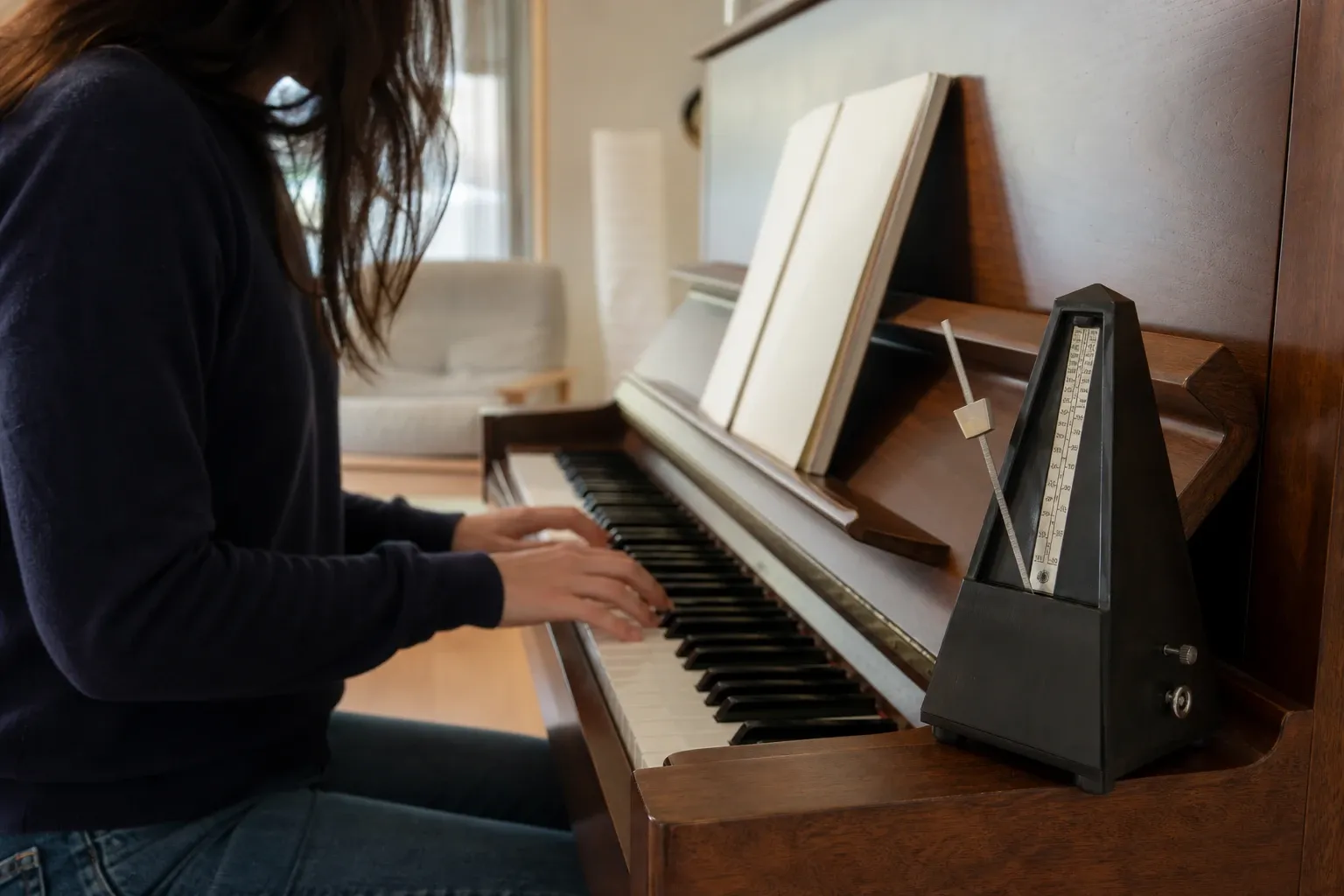
With 10 minutes, do 5 on scales and 5 on whatever you’re playing. A metronome (a device that clicks a steady beat) or a slow count of four keeps your timing honest.
Quick tip: set the metronome slow enough that you never stumble, one note per click.
If you’d like chords and ear playing alongside scales, Pianoforall is a self-study course; the maker says it teaches rhythm-style playing, chords and blues scales, and it’s for people who like video lessons. It doesn’t watch your technique or give live feedback.
Common scale mistakes and how to fix them
The most common scale mistakes are rushing, tension, an uneven thumb and skipping the left hand. Each has a simple fix.
- Rushing: drop the tempo until there are no stumbles, then nudge it up.
- Tense wrist or shoulders: pause, let your arms drop, and shake your hands out before restarting.
- Uneven thumb: practise only the crossover, five slow repeats.
- Skipping the left hand: give it equal time, since it often needs more.
Example: if the thumb thumps on F, play just E-F-G ten times, aiming for a quiet F.
Do scales help with chords and playing by ear?
Scales help with chords and playing by ear because a major scale supplies the notes for a key’s chords. A chord is several notes played together.

In C major, chords built on C, F and G use only scale notes. See our piano chords in the key of C page for the full set.
Knowing the key also narrows your search when you pick out a melody by ear. If a tune sounds like it lives on white keys, start with the C scale.
Scales are one tool. Chords and songs keep practice fun, which keeps you coming back. If you’re newer to all this, our guide to how to teach yourself how to play the piano covers the bigger picture.
Scale practice checklist
A scale practice checklist turns the routine into a daily tick-box. Use one row per day.
Move on to the next key when the scale is even at a slow tempo twice in a row.
Where does this fit in your wider practice?
This scale routine is one block of a full session, and your piano practice routine for beginners shows how to build the rest around it. If you’re coming back to the keyboard later in life, our adult piano learner overview covers what to expect.
For chords to go with your scales, try easy piano chords for beginners.
If you want a self-study course with chords and ear playing in one place, Pianoforall is $49 once. Our button opens its 7-day trial page, where you can buy outright or start the trial (the trial needs payment details and charges $49 when it ends unless you cancel). This is an affiliate page, so we may earn a commission.
Try or buy Pianoforall on the official site60-day money-back guarantee
Common questions
- Do I need to learn every scale?
No. As an adult beginner, a handful of keys is plenty, such as C, G, F, D and A minor. Add more only if you want to. Chords and pieces often matter more for enjoyment than a full set of twelve keys.
- Should I practise scales hands together or separately?
Start with hands separately so you can learn the fingering without stress, then join them at a slow tempo. Each new key can follow the same order, and if hands together falls apart, drop back to separate hands for a few repeats.
- Should I learn minor scales as a beginner?
Yes, but after a few major keys feel steady. A minor is a friendly start because it uses only white keys. Learn the natural minor first, which is the plain version, and leave other minor forms for later.