Heads up: some links here are affiliate links. If you buy through one, we may earn a commission; your price stays the same. Details
Pianoforall: A self-paced online piano course that starts with chords and rhythm, with video lessons and downloadable ebooks, for one $49 payment.
Try or buy Pianoforall on the official site60-day money-back guarantee
In this guide (8 sections)
- What is a piano chord, in plain words?
- Which easy piano chords should you learn first?
- How do you play chords with both hands?
- Worked example: accompany a simple tune with three chords
- How do you change chords smoothly?
- Can you learn piano chords by ear?
- Where do you go after these first chords?
- How does this fit into learning piano as an adult?
What is a piano chord, in plain words?
A piano chord is three or more notes played at the same time. The beginner version is a triad (a three-note chord) built from a root, a third and a fifth.
The root note is the note the chord is named after. For C major, the root is C. Count up the white keys: C, E, G. That’s the whole chord.
Pianote explains that a major triad has four half steps between the root and the third, and three between the third and the fifth. A half step is the distance to the very next key, black or white. So C to E is four half steps, and E to G is three.
Chord symbols are short labels for these note sets. C means C major, Am means A minor, and G7 means G with an added seventh note. A chord chart is simply a list of those labels.
Quick tip: Find middle C, then press C, E and G together. Hold them for a few seconds and listen. That’s your first chord.
Which easy piano chords should you learn first?
Learn C, G and F major, then A minor, D minor, E minor and G7. They sit on white keys, so there are no sharps or flats to think about yet.
Major chords sound bright. Minor chords sound sadder, and the only difference is that the middle note drops one half step. Yamaha’s lesson notes say these shapes are usually played with thumb, middle finger and pinky, which is fingers 1-3-5 in the right hand.
1. C major
C major is C-E-G, played with right-hand fingers 1-3-5. Add a left-hand C below as the root. It’s the home chord for the key of C.
2. G major
G major is G-B-D, also fingered 1-3-5. Left-hand root is G. It sounds like it wants to move back to C.
3. F major
F major is F-A-C, fingered 1-3-5, with an F in the left hand. Together with C and G, it gives you the three chords behind countless folk songs and nursery tunes.
4. A minor
A minor is A-C-E, fingered 1-3-5, with an A in the left hand. It’s the relative minor of C, meaning it shares the same white keys and feels like C’s quieter cousin.
5. D minor and E minor
D minor is D-F-A and E minor is E-G-B, both 1-3-5. They fill out the white-key chords of the key of C. Add them once the first four feel comfortable.
6. G7 as your first seventh chord
G7 is G-B-D-F, a dominant 7th chord (a major triad plus a flat seventh). The 7 chord rule in simple terms: that extra note adds tension, and the chord pulls back toward the home chord, here C. Most people play it with fingers 1-2-3-5 or simply drop the fifth (D) and use 1-2-5.
What can wait: diminished chords (three half steps stacked twice, a tense sound), augmented chords (four half steps stacked twice, a floating sound), sus chords (the third is swapped for a neighbour note) and extended chords (notes stacked beyond the seventh). You’ll meet them later. The page on major, minor, diminished and augmented chords covers them when you’re ready.
How do you play chords with both hands?
The right hand plays the triad and the left hand plays the root note or an octave (the same note, eight white keys lower). This split keeps things simple while sounding full.
Right hand versus left hand
The right hand sits around middle C and plays three notes together. The left hand plays one low note, such as C for a C chord, once per beat or once per bar.
Example: right hand holds C-E-G while left hand plays C on beats 1 and 3. Count “1, 2, 3, 4” slowly.
Fingering that keeps your hand relaxed
Fingering 1-3-5 with a gently curved hand lets each finger fall onto its key without stretching. Keep your wrist loose and level rather than stiff. If something feels uncomfortable, stop and ask a qualified professional rather than pushing through.
Inversions as a shortcut for smooth moves
An inversion is the same chord with its notes in a different order. Yamaha’s guide shows moving C to the top to get E-G-C, then G-C-E. Same chord, different shape.
Why it helps: moving from C (C-E-G) to F is a big jump. Use the second inversion of F (C-F-A) instead, and your thumb barely moves.
Worked example: accompany a simple tune with three chords
In the key of C, the chords C, F and G (or G7) can accompany many simple tunes. This pattern is called I-IV-V, using the first, fourth and fifth notes of the scale as chord roots.
Skoove describes a progression like C, F, G, C and notes that G creates tension, C gives release and F acts as a contrast between them. That’s why it sounds right: the chords push and settle.
Try this four-bar pattern, one chord per bar of four beats:
| Bar | Chord | Left hand | Right hand |
|---|---|---|---|
| 1 | C | C on beats 1 and 3 | C-E-G |
| 2 | F | F on beats 1 and 3 | F-A-C |
| 3 | G7 | G on beats 1 and 3 | G-B-D (or with F) |
| 4 | C | C on beat 1, hold | C-E-G |
How to choose a chord for a tune: hum the melody and find the note that lasts longest in each bar. If it’s C, E or G, try C. If it’s F, A or C, try F. If it’s G, B or D, try G.
Go slowly, around a pace you could walk to. Keep the left-hand beat steady. If one chord sounds wrong, swap it for another and listen.
For a good first tune, look at the easy piano songs for beginners page. A simple folk or nursery melody works fine.
How do you change chords smoothly?
Switch between two chords slowly and evenly, moving your whole hand as one shape rather than finger by finger. A 15 to 20 minute session is plenty for most adults.
Try this routine:
- Spend 5 minutes switching between C and F, one chord every four beats, with a slow metronome (a clicking beat).
- Spend 5 minutes on C and G.
- Add the third chord and play C, F, G, C for 5 minutes.
- Spend the rest playing a tune you like.
Common mistakes:
- Lifting the whole arm instead of just the fingers.
- Staring at your hands the whole time.
- Speeding up as the pattern gets familiar.
Keep a cheat list in the order you learned the chords: C, G, F, Am, Dm, Em, G7. Write each with its notes, such as C = C-E-G. For a longer routine, see piano practice routine for beginners.
Can you learn piano chords by ear?
Yes, you can learn chords by ear, starting with hearing major versus minor, then the home chord versus the others. Both skills grow with short, regular listening.
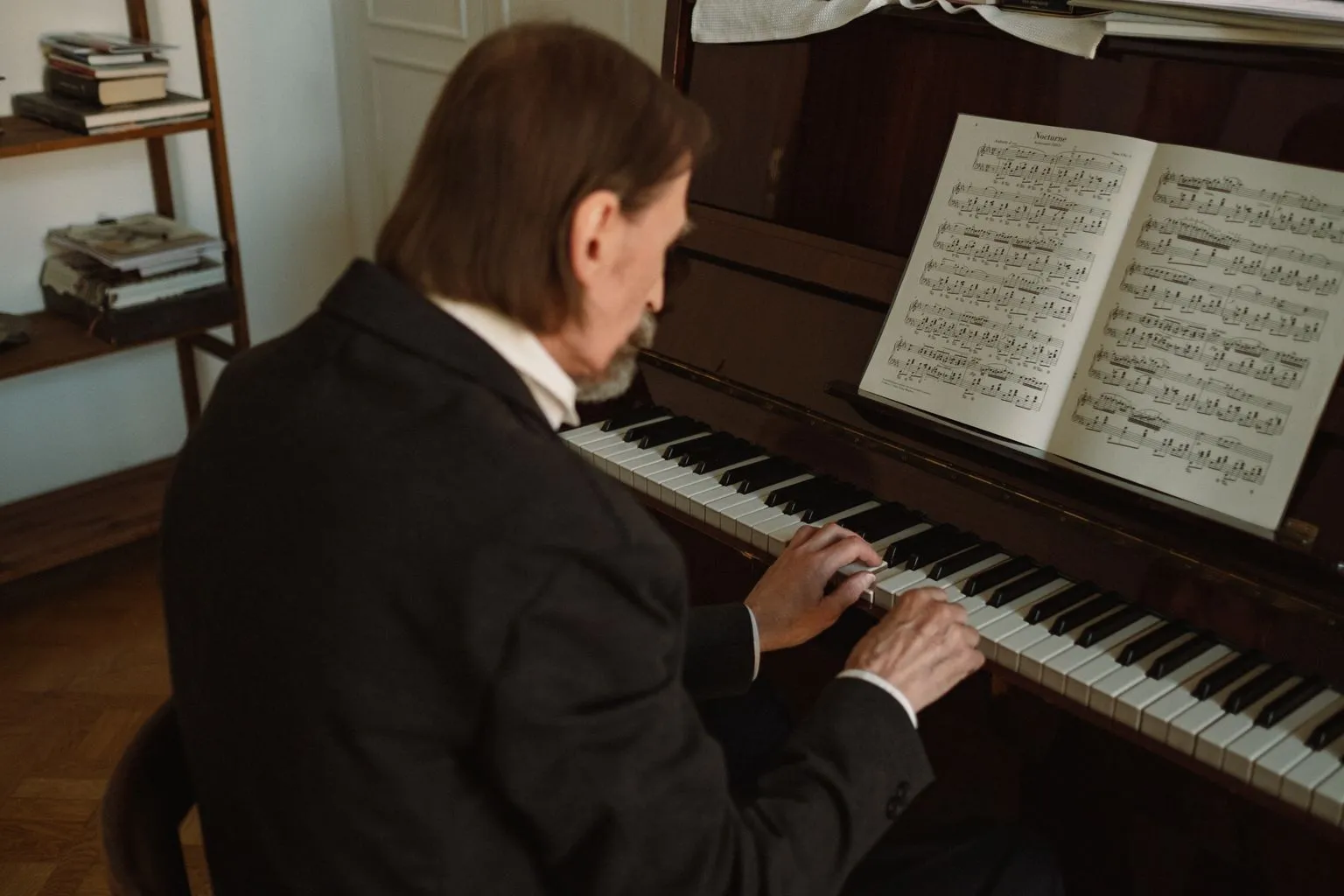
Play C major, then A minor. Notice the bright and sad difference. Then play C, F and G in turn while humming a simple tune, and keep the one that fits.
Charts and ears work together. A chord chart shows the shapes, and your ear chooses which one to use. You don’t need sheet music for this, just the labels and your hearing. Our piano chord chart page shows how to read the diagrams, and learn piano by ear goes deeper on the listening side.
On “how to play piano pdf”: a printed chord chart is handy, but the cheat list above does the same job for the first few chords.
Check the current Pianoforall course, price and trial billing terms on the vendor’s site.
Try or buy Pianoforall on the official site60-day money-back guarantee
Where do you go after these first chords?
After C, G, F and A minor, add D minor, E minor and G7, then try the same shapes in other keys. This is where the pattern starts to repeat.
Next chords to add
Try a second key such as G major, with chords G, C and D. The same I-IV-V pattern applies. Then explore seventh chords; the seventh and jazz chords page is a good next step, and chord progressions on piano shows more patterns.
A structured course option
Pianoforall is a self-study course with video lessons and ebooks. The maker says it teaches rhythm-style playing, chords, blues, jazz and classical. It suits people who want chord-first learning with a set order. It’s self-paced, so it doesn’t offer individual live feedback.
It’s $49 once for the complete course. Our button opens its 7-day trial page, where you can buy outright or start the trial (the trial needs payment details and charges $49 when it ends unless you cancel). Free methods work too, and the free piano lessons page covers their gaps.
How does this fit into learning piano as an adult?
These starter chords are a first step in the wider path of learning piano as an adult. Chords give you something playable quickly, and they feed into by-ear skills and progressions.
From here, chord progressions on piano shows how to link chords into longer patterns, and learn piano by ear builds the listening side. Pick one tune, play C, F and G under it for 15 minutes a day, and see how it feels.
More guides in Chords
Common questions
- How long does it take to learn basic piano chords?
It varies by person and practice time. Many beginners can play C, F and G shapes within a few short sessions, but smooth changes take longer. Aim for 15 to 20 minutes most days. No timeline is guaranteed.
- Do I need to know music theory to play chords?
No. You can start by learning the shapes and listening to the sound. A little theory helps later, such as knowing that a triad is root, third and fifth, but it isn’t required for your first chords.
- How many chords do I need to play a song?
Many simple songs use only three or four chords. In the key of C, C, F and G cover a lot of folk and nursery tunes. Adding A minor opens up more songs without learning many new shapes.