Heads up: some links here are affiliate links. If you buy through one, we may earn a commission; your price stays the same. Details
For structured lessons between practice sessions, compare the course's approach and access options.
Try or buy Pianoforall on the official site60-day money-back guarantee
In this guide (9 sections)
- How are the piano keys laid out?
- What are the names of the white keys?
- How do the groups of two and three black keys help me find notes?
- Where is middle C?
- What are the black key names, sharps and flats?
- Labelled keyboard chart: octave pattern and note names
- How do piano notes connect to sheet music and sound?
- What mistakes do beginners make when naming keys?
- Where do I go next with piano notes and keys?
How are the piano keys laid out?
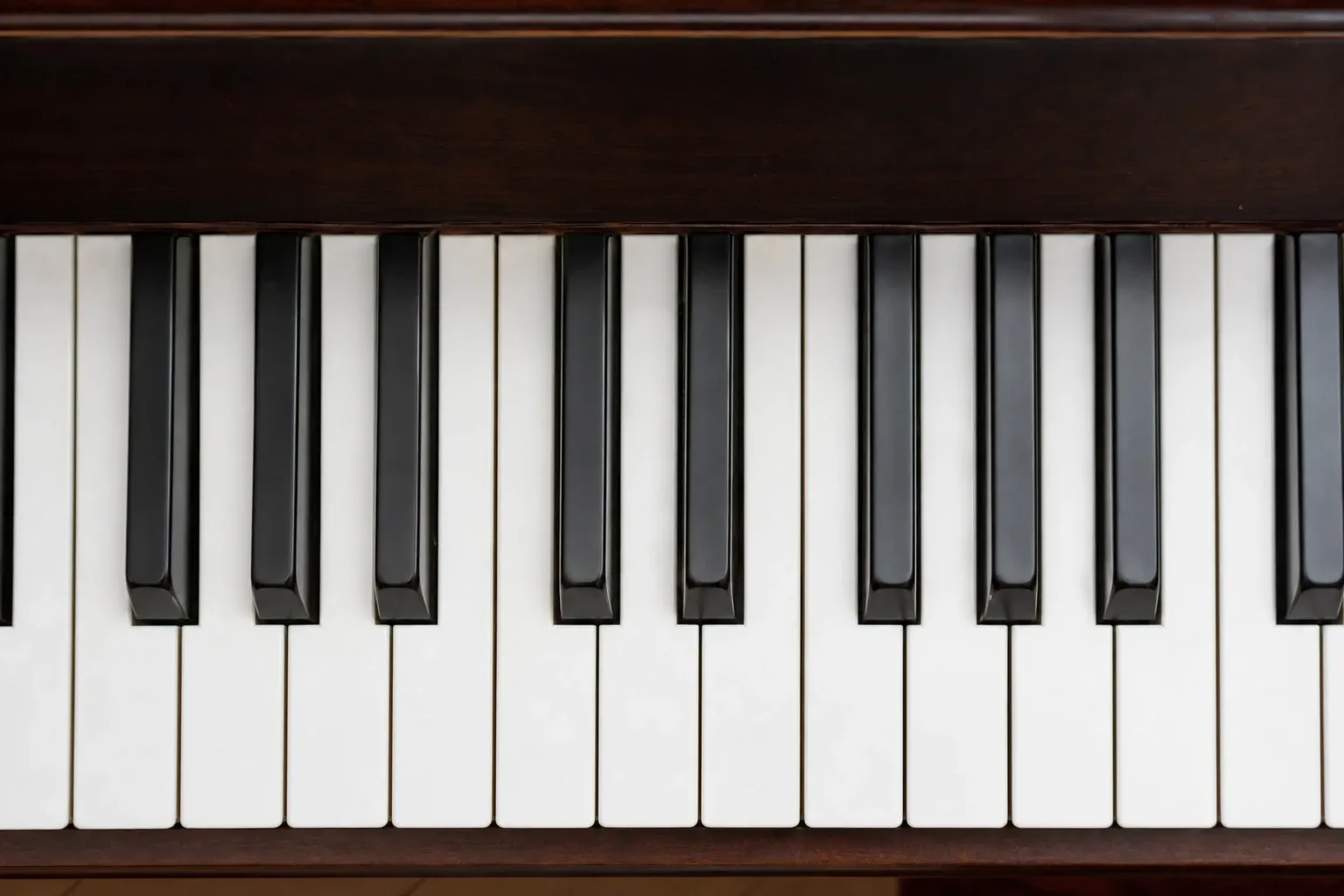
The piano keys form a repeating pattern of white and black keys, with low notes on the left and high notes on the right.
Think of it as a wallpaper tile. Learn one tile and you know every other one.
White keys and black keys
Each octave (the span from one note to the next note with the same name) has seven white keys and five black keys. The white keys are the natural notes, and the black keys fill in the gaps between them.
The 12 notes that repeat
The 12 notes in each octave are the seven white keys plus the five black keys. After the twelfth, the pattern starts again, a little higher.
How many keys does a piano have?
A full piano has 88 keys: 52 white and 36 black. A smaller keyboard has the same pattern with fewer octaves, so nothing you learn is wasted.
Quick tip: If you have a 61-key keyboard, you are simply missing some tiles at each end. The layout in the middle is identical.
What are the names of the white keys?
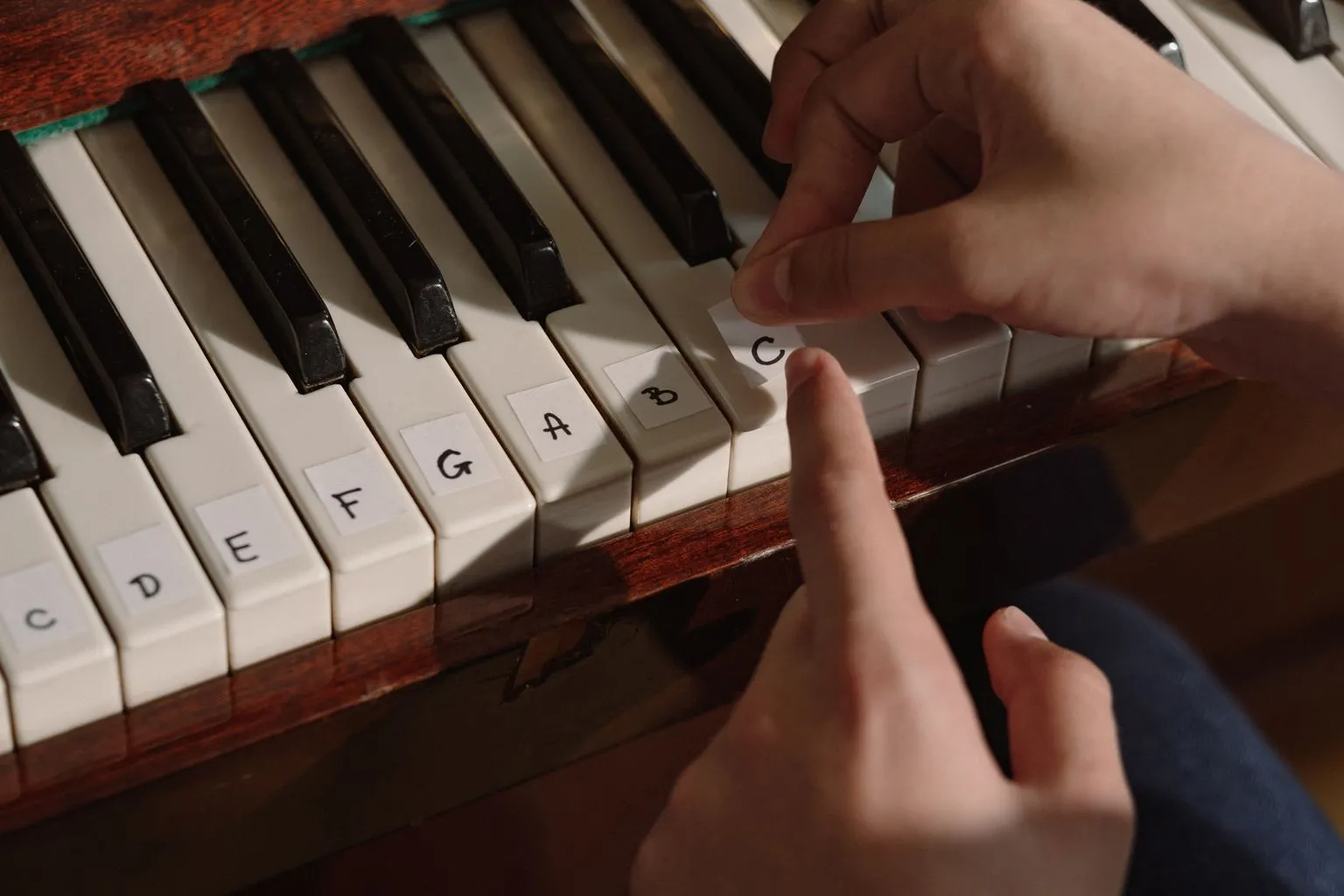
The white keys use only seven letters, A B C D E F G, called the musical alphabet. After G, the letters start again at A.
The musical alphabet A to G
Moving right takes you higher in pitch, and moving left takes you lower. So the next white key right of G is a higher A.
Why the letters restart after G
The letters restart because notes with the same name sound like “the same note, higher or lower”. One full cycle from a C to the next C is an octave.
Example: play C, then the next white key right, then the next, all the way to the following C. You have just played one octave of white keys.
How do the groups of two and three black keys help me find notes?
The black keys come in groups of two and three, and those groups are landmarks you can spot from any seat.
Finding C, D and E around the two black keys
C is the white key just left of the two-black-key group. D sits between the two black keys, and E is just right of the group.
Finding F, G, A and B around the three black keys
F is just left of the three-black-key group. G and A sit between its black keys, and B is just right.
A quick memory method: the doghouse and grandma’s house
Picture the two black keys as a doghouse, with D (for dog) in the middle. Picture the three as grandma’s house, with G, A and B nearby.
The rule is simple: jump to the nearest landmark, then count one or two keys. You never need to count from the far left end.
Where is middle C?
Middle C is the C closest to the centre of the keyboard, and it works as your home base.
Finding it on 88-key pianos and smaller keyboards
On a full piano, it is the C near the centre, often close to the brand name. On a short keyboard, use the C nearest the middle of the keys.
Octave numbering such as C4
Many systems call middle C “C4”, with C3 an octave below and C5 an octave above. Conventions can vary between brands and apps, so check your keyboard’s manual if numbers don’t match.
Middle C is also the anchor note between the treble and bass staves in written music.
What are the black key names, sharps and flats?
Each black key is named from its white neighbours using a sharp (#, one key to the right) or a flat (b, one key to the left).
Sharps and flats explained
The black key just right of C is C sharp. The same key is also D flat, because it’s just left of D.
Enharmonic spellings such as C# and Db
Two names for one key are enharmonic spellings. Which one you see depends on the key of the music.
The full list is: C, C#/Db, D, D#/Eb, E, F, F#/Gb, G, G#/Ab, A, A#/Bb, B.
E to F and B to C have no black key between them. That’s why the gap in the black key pattern falls where it does.
Labelled keyboard chart: octave pattern and note names
This chart shows one octave of keys with every name in place, so you can check yourself against it.
Use it like flash cards. Cover the labels, point to a key, say its name, then uncover to check.
| Landmark | Notes nearby | Memory hook |
|---|---|---|
| Two black keys | C, D, E | Doghouse, D in the middle |
| Three black keys | F, G, A, B | Grandma’s house |
| E to F, B to C | No black key between | Two white keys side by side |
How do piano notes connect to sheet music and sound?
Each key name matches a spot on the staff (the five lines of written music), and each also has a sound you can learn to recognise.
Treble clef, bass clef and the grand staff
The right hand usually reads the treble clef and the left hand the bass clef. Together they form the grand staff, meeting at middle C. For more, see our guide on how to read sheet music for piano.
Matching keys to sounds by ear
Play a note slowly and hum it back. Then say its name, so key, name and sound link together.
Example: play C, then G, and hum each. Do that for 5 minutes in a 15 to 20 minute session.
These note names are enough to begin chords and playing by ear. Pianoforall is one self-study course where beginners go on to apply them, and the maker says it starts with chords and rhythm.
What mistakes do beginners make when naming keys?
The most common mistake is counting from the left end of the keyboard instead of starting from a landmark.
- Counting from the end. Jump to the nearest black key group instead.
- Forgetting double names. Every black key has a sharp name and a flat name.
- Mixing up the groups. Two black keys means C, D, E. Three means F, G, A, B.
- Thinking small keyboards differ. They share the same pattern, just shorter.
Keep the key surfaces clean so the landmarks stay easy to see.
Where do I go next with piano notes and keys?
Knowing the keys is the first step in learning piano as an adult, and it fits well with everything else you’ll try.
If you’re deciding where to begin, read how to start learning piano. When you’re ready to use these notes in shapes, the piano chord chart is the next stop. If you play a smaller board, how to learn keyboard covers that setup.
Common questions
- Do digital keyboards have the same layout as acoustic pianos?
Yes. A digital piano or keyboard uses the same pattern of white keys and black key groups as an acoustic piano. Smaller models just have fewer octaves, so the notes you learn on one carry straight over to the other.
- Should I put stickers on my keys?
Stickers can help for the first few days, but they can also become a crutch. Try removing them early and rely on the two and three black key groups. Use removable labels and keep the keys clean so the landmarks stay clear.
- Which notes make up a C major scale?
The C major scale uses only white keys: C, D, E, F, G, A, B, then C again. It starts on a C and climbs one octave, which makes it a handy first pattern to play and name aloud.