Heads up: some links here are affiliate links. If you buy through one, we may earn a commission; your price stays the same. Details
Pianoforall: A self-paced online piano course that starts with chords and rhythm, with video lessons and downloadable ebooks, for one $49 payment.
Try or buy Pianoforall on the official site60-day money-back guarantee
In this guide (9 sections)
- What does a good beginner piano practice routine look like?
- How long should a beginner practise each day?
- How do I practise each part properly?
- What beginner mistakes should I avoid, and how do I fix posture and hand position?
- Your printable piano practice checklist
- What if I have limited time or a busy week?
- How do I know I am improving and stay motivated?
- Can a structured course make the routine easier?
- Where does this routine fit in learning piano as an adult?
What does a good beginner piano practice routine look like?
A good beginner piano practice routine is a short, repeatable session with a fixed order, so you never waste time deciding what to play.
This page is for adult beginners and returning players teaching themselves at home. Nothing here replaces a teacher’s feedback on your hands, but it will give your practice a shape.
The five parts of every session
Every session has five parts: warm-up, review, new material, play for fun, and a quick stop note.
- Warm-up: slow finger patterns or a scale (a run of notes in a set order).
- Review: something you learned last week, played smoothly.
- New material: one small thing, such as a four-bar section or one new chord.
- Play for fun: a song you enjoy, mistakes allowed.
- Stop note: one line on what to do next time.
Set one goal per session, like “play bars 1 to 4 of this tune hands together at a slow pace.” When you’ve done it, you’re finished.
Over a week, the parts cover the usual pillars: technique (how you use your fingers), scales and chords, tunes, rhythm, ear training (working out notes by listening) and theory (the why behind the notes).
Why short daily practice beats one long weekend session
Short daily practice suits beginners because each day you meet the material again, and a fixed order makes starting easy.
Think of watering a plant: a little every day does more than a bucket on Sunday. That’s everyday advice, not a research finding. If daily isn’t possible, aim for most days and see the busy-week section below.
How long should a beginner practise each day?
A beginner can practise 15 minutes a day if busy, 30 for steady work, or 45 once the habit feels easy.
The tables show how the minutes can be split. Use whichever length fits today, and swap freely.
| Part | 15 min | 30 min | 45 min |
|---|---|---|---|
| Warm-up and technique | 3 | 5 | 7 |
| Review | 3 | 6 | 8 |
| Scales, chords or ear training | 2 | 5 | 8 |
| New material | 5 | 10 | 15 |
| Play for fun | 2 | 3 | 6 |
| Stop note | 0 (30 sec) | 1 | 1 |
The stop-note minute is rounded; it takes under a minute.
15 minutes: the minimum that still works
Fifteen minutes works when you keep it to one goal, such as one new chord shape and one tune section.
This suits absolute beginners and anyone with a full day job. Example: play C, F and G chords slowly, then switch between two of them in steady beats.
30 minutes: the steady plan
Thirty minutes gives room for review, a real new section and a short drill on chords or ear training.
Example for week 1: find middle C, play five-finger patterns, learn the first two bars of one tune. By month 3, shift minutes toward chords and tempo work, since the warm-up is faster.
45 minutes: when you are ready for more
Forty-five minutes suits learners whose 30-minute sessions feel comfortable and who want more tunes or ear work.
Returning learners can start here, adding a little sight reading (reading notes from a page) and improvising (making up music) over a simple chord loop.
Slow, uneven progress is normal, and a rest day is fine.
How do I practise each part properly?
Practise each part slowly and in small pieces, so what you repeat is what you want to keep.
Technique and finger exercises
Technique work means simple finger patterns played evenly and slowly, for two to five minutes.
Example: play five notes up and down with one hand, each note the same loudness. Stop if anything feels strained.
Hands separately, then together
Playing hands separately first lets each hand learn its part before you combine them at a slow tempo.
Tempo (BPM) means beats per minute. Start around 60 BPM, and raise it only when you can play three clean runs in a row.
Breaking a piece into small sections
Looping two to four bars beats replaying the whole piece, because you fix the tricky spot instead of the easy parts.
Example: bars 5 to 8 are the hard ones. Play only those eight times, then link them to bar 4.
Chords, scales and playing by ear
Chords (notes played together), scales and ear training work best as small daily drills of two to five minutes.
Try one chord a day, then hear it against another. Later, add diatonic 7th chords, which are four-note chords built from a key’s own notes. Our piano scale practice routine goes deeper on scales, and learn piano by ear covers listening drills.
Rhythm, tempo and the metronome
A metronome or backing beat keeps your rhythm steady by giving you a click to match.
Set it slow and clap the pattern first. Later you can try triplets (three even notes in one beat) and swing feel (long-short pairs that give jazz its bounce).
Sight reading and improvisation fit as small add-ons: two minutes of reading a very easy line, or five notes made up over one chord.
What beginner mistakes should I avoid, and how do I fix posture and hand position?
The most common beginner mistakes are rushing, repeating errors, skipping the warm-up and only playing what you already know.
These are general habits, not medical advice. If something hurts, stop and see a qualified professional.
Posture and hand shape checks
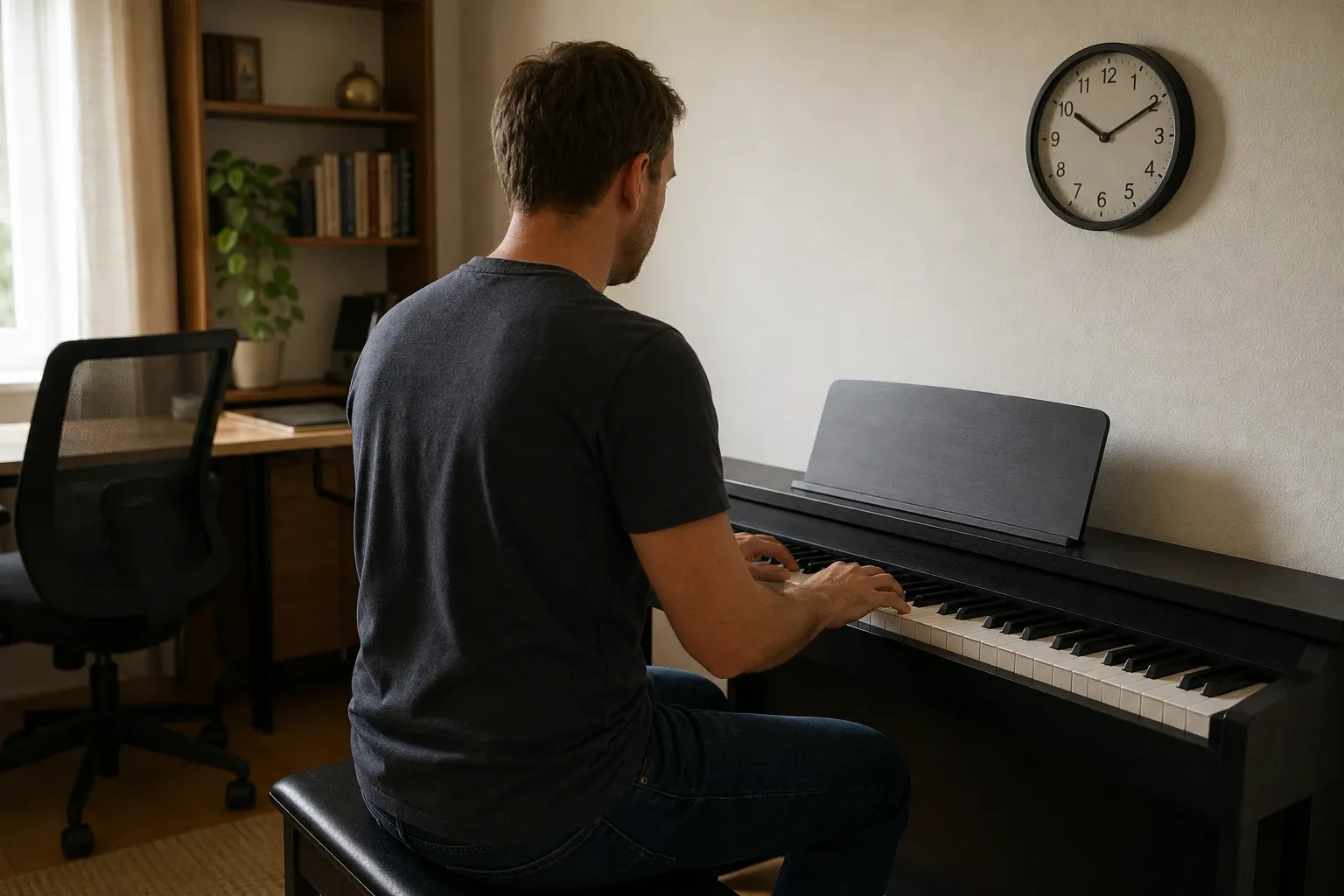
Good setup means a seat height where your forearms are roughly level, shoulders relaxed and fingers gently curved.
Quick check before each session: sit, drop your shoulders, rest hands on the keys. If your hands feel tense or sore, stop and reset rather than push on.
Practising mistakes in
Repeating a mistake at full speed teaches your hands the mistake, so slow down whenever the same error returns.
Example: if you fumble bar 6 three times, halve the tempo and play it correctly twice before moving on. Also don’t let play-for-fun swallow the whole session, because new material is what moves you forward.
Your printable piano practice checklist
This checklist is a tick-box list for one session, plus a weekly row to log days practised and one win.
For 15 minutes, tick only posture, warm-up, one new section and stop note. For 30, add review and tempo check. For 45, add a chord or ear drill and a longer play-for-fun slot.
Copy it by hand or paste it into a note on your phone. Seeing the ticks builds the habit.
What if I have limited time or a busy week?
On a busy week, shrink the session to a 10-minute core instead of skipping it.
Two ways to shrink a session
You can shrink a session by dropping to a core, or by splitting it into two short blocks.
- 10-minute core: a 3-minute warm-up and one small section for 7 minutes.
- Two blocks: 5 minutes in the morning, 5 in the evening.
Try never to skip two days in a row. Plan travel and tired days ahead, for example by deciding now that Friday is a 10-minute day.
Practising without a teacher or with apps
Apps, videos and structured courses are guides for what to play, and the routine is still what gets you playing.
Without a teacher, nobody watches your hands, so record yourself now and then and check your posture list. For more setups, see how to teach yourself how to play the piano.
How do I know I am improving and stay motivated?
You’re improving when the same piece gets easier, faster or cleaner, and you can measure that with simple notes.
Simple ways to measure progress
Record yourself once a month and compare tempo, accuracy and how relaxed it feels.
Track the BPM of one piece and count the chords you can change between smoothly. Example: 60 BPM in week 2, 72 in week 6.
What to do when motivation drops
When motivation drops, change one thing: swap in a favourite song, shorten sessions or alter your goal.
Celebrate small wins instead of comparing yourself with others. Learning at your age has its own pace, and how hard it is to learn piano depends a lot on your routine.
Can a structured course make the routine easier?
A structured course can make the routine easier because it decides your new material for you each day.
Pianoforall is one option. According to its maker, it teaches rhythm-style playing, chords, blues, jazz and classical through video lessons and downloadable ebooks. Use the current lesson as your new-material slot, and keep the warm-up, review and play-for-fun parts.
It suits adults who want chords and playing by ear. Skip it if you want strict classical sight reading only. The course doesn’t watch your hands, so keep the posture checks.
It’s $49 once for the complete course. Our Pianoforall review has more detail.
Our button opens Pianoforall’s 7-day trial page, where you can buy outright or start the trial (the trial needs payment details and charges $49 when it ends unless you cancel).
Try or buy Pianoforall on the official site60-day money-back guarantee
Where does this routine fit in learning piano as an adult?
This routine is the daily engine of adult piano learning, and the wider plan sits in our guide to the adult piano learner.
That overview covers goals, choices of method and what to expect. If you’re still deciding how to study, start with how to teach yourself how to play the piano, then come back and pick your 15, 30 or 45 minute plan for tomorrow.
More guides in Practice and playing
Common questions
- Should I practise piano every day?
Most days is a good aim for beginners, because short, frequent sessions keep material fresh. Daily isn’t required, and a rest day is fine. If a day gets away from you, do a 10-minute core session the next day rather than doubling up.
- Is it better to practise in the morning or evening?
The best time is the one you’ll keep. Morning suits people who want it done before the day gets busy; evening can feel relaxed. Pick a slot, attach it to an existing habit, and keep it for a few weeks.
- Can I practise on a keyboard instead of a piano?
Yes, for most beginner practice. Touch-sensitive keys, which respond to how hard you press, and full-size keys help. The Pianoforall maker lists at least 61 full-size touch-sensitive keys and a sustain pedal as starting equipment for its course.