Heads up: some links here are affiliate links. If you buy through one, we may earn a commission; your price stays the same. Details
For structured lessons between practice sessions, compare the course's approach and access options.
Try or buy Pianoforall on the official site60-day money-back guarantee
In this guide (8 sections)
- What am I actually looking at on a page of piano music?
- How do I read treble clef and bass clef notes?
- How do ledger lines, sharps, flats and key signatures work?
- How do I read rhythm, time signatures and tempo?
- Let’s read one bar together, step by step
- How do I practise sight reading without getting stuck?
- Do I have to read sheet music to play piano?
- Where does reading fit in your wider piano plan?
What am I actually looking at on a page of piano music?
Piano sheet music is two sets of five lines stacked together, with notes placed on them to tell you which key to press and for how long. Pitch (how high or low a note sounds) comes first. Timing comes second.
The staff, lines and spaces
A staff is five lines with four spaces between them, and each line or space is one note name. The higher a note sits on the staff, the further right you play on the keyboard.
Example: draw five lines and put a dot on the bottom line, then one on the next space up. The second dot is the next white key to the right of the first.
The grand staff and middle C
The grand staff is the treble and bass staves joined by a brace (the curly bracket on the left). Middle C is the note that sits between them, and it’s your reference point.
Find middle C on your keyboard near the centre, just left of a group of two black keys’ neighbours. If you want help finding it, the piano key note layout page maps every white key.
How do I read treble clef and bass clef notes?
Treble clef (the upper staff, with the swirly sign) holds the higher notes, and bass clef (the lower staff, with the backwards C and two dots) holds the lower ones. The right hand usually reads treble and the left usually reads bass.
Treble clef lines and spaces
Treble lines, bottom to top, are E G B D F. The spaces spell FACE.
Bass clef lines and spaces
Bass lines, bottom to top, are G B D F A. The spaces are A C E G.
| Clef | Lines (bottom to top) | Spaces (bottom to top) | Landmark note |
|---|---|---|---|
| Treble | E G B D F | F A C E | G (second line up) |
| Bass | G B D F A | A C E G | F (fourth line down from top) |
| Between both | Middle C sits on a ledger line | Middle C |
Mnemonics that help (and their limits)
A mnemonic is a memory phrase, such as “Every Good Boy Does Fine” for the treble lines. It’s a fine starter, but spelling out a phrase for every note is slow.
Better: learn the landmarks (middle C, treble G, bass F), then read by distance. A note two steps above treble G is B. Hands can swap clefs, so check each piece rather than assuming.
Quick tip: Learn one clef for a week, then add the other. Five minutes of flashcards beats one long session.
How do ledger lines, sharps, flats and key signatures work?
Ledger lines, sharps, flats and key signatures all extend or adjust the basic note map. Each is simple once you take it alone.
Ledger lines above and below the staff
Ledger lines are short extra lines that extend the staff for notes too high or low to fit. Count from a known note: middle C is one ledger line below treble, or one above bass.
Sharps, flats and naturals
A sharp (♯) means play the black key just to the right of the note. A flat (♭) means the black key just to the left. A natural (♮) cancels either one.
These marks are accidentals when they appear beside a single note. An accidental lasts until the end of that measure (one bar, the space between two vertical lines), then resets.
Reading a key signature
A key signature is the set of sharps or flats written at the start of each staff. It tells you those notes are sharp or flat all through the piece, so you don’t need a mark on each one.
Example: one sharp on the F line means every F is F sharp. Beginners can start with pieces with no sharps or flats.
How do I read rhythm, time signatures and tempo?
Rhythm in sheet music is shown by the shape of each note, and the time signature tells you how to group them. Count out loud and clap before you play.
Note lengths and rests
In 4/4, a whole note lasts four beats, a half note two, a quarter note one and an eighth note half a beat. A dot after a note adds half its length. A tie joins two notes into one longer sound. Each length has a matching rest, which is silence for that long.
Time signatures and beats per measure
The top number of a time signature is beats per measure, and the bottom number says which note counts as one beat. So 3/4 means three quarter-note beats per bar, like a waltz.
Tempo markings and dynamics
Tempo is the speed. Italian words such as allegro (fast and lively) and andante (walking pace) set it. Dynamics are loudness: piano means soft and forte means loud.
Let’s read one bar together, step by step
To read a bar, decode it in order: clef, key, time, notes, then count. Here’s one in 4/4, no sharps or flats.
Treble: C, E, G, then a half note C above. Bass: a whole note C.
- Clef: treble on top, bass below.
- Key: nothing after the clef, so all white keys.
- Time: 4/4, four beats in the bar.
- Pitch: right hand starts on middle C, then E, then G, then the C above. Left hand plays the C below middle C.
- Rhythm: the right-hand notes are quarter, quarter, half (1, 2, 3-4). The left-hand whole note rings for 1-2-3-4.
Play the left hand once and hold it while the right hand moves. That’s how both staves fit into one measure.
How do I practise sight reading without getting stuck?
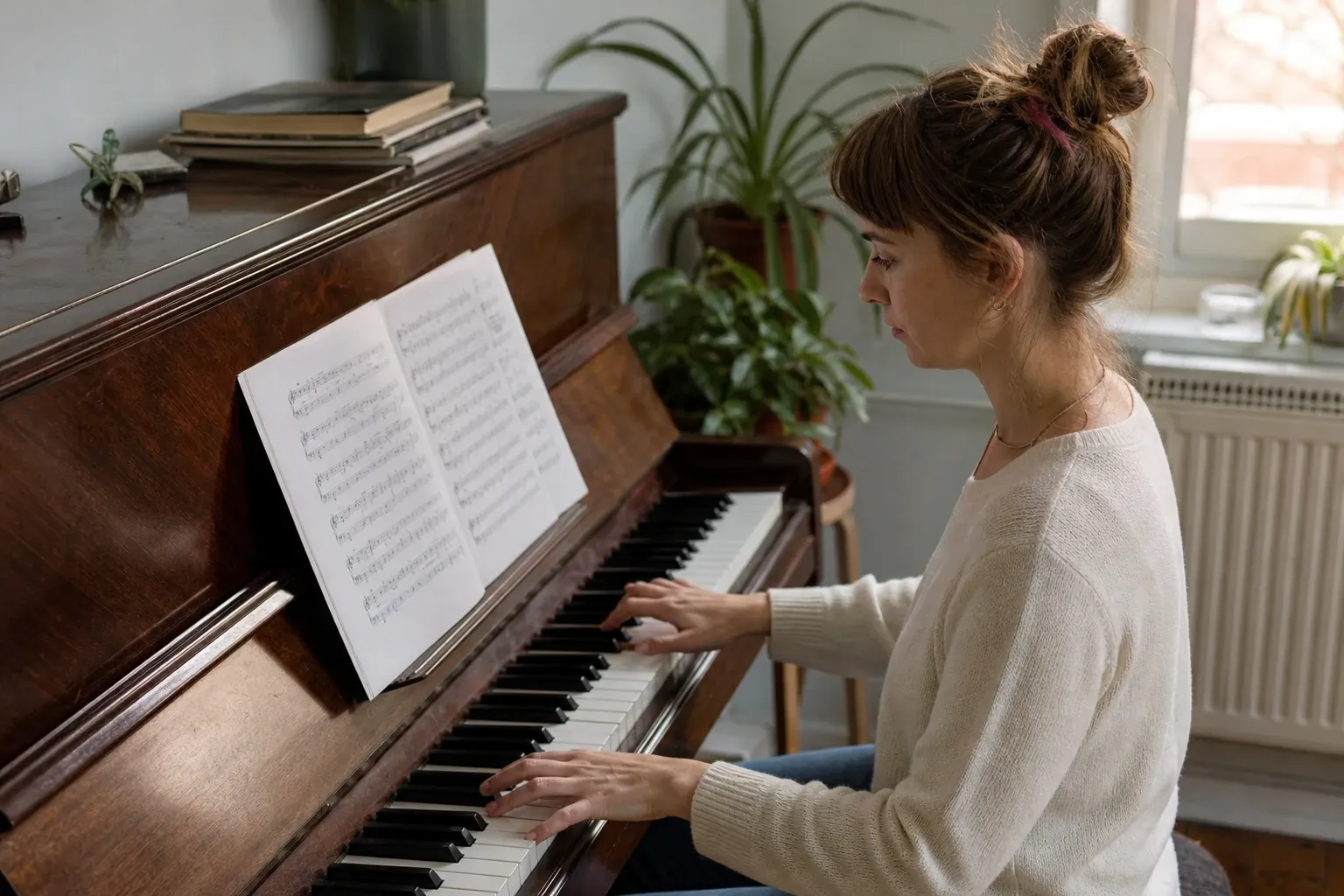
Sight reading means playing music you haven’t seen before, and you build it with a few minutes daily on very easy material. Aim for 10 to 15 minutes, well below your playing level.
Common beginner mistakes
- Watching your hands the whole time; glance down only to find your place.
- Naming every note instead of recognising shapes and steps.
- Ignoring rhythm to get the notes right.
- Starting with pieces that are too hard.
Beginner pieces and method books to practise from
Choose pieces with a few notes and steady rhythm. The easy piano songs for beginners page lists good starting points. Free apps and printable charts cost nothing and suit quick drills, while paid method books give a planned order and more pieces; see books to teach yourself piano.
How long it realistically takes
Progress varies widely, and fluency tends to build over months rather than days. This page draws on general teaching practice rather than a study, so treat any timeline as a rough guide.
Do I have to read sheet music to play piano?
No, you don’t have to read sheet music to play piano, though reading matters most for classical and written pieces.
When chord-based playing is a sensible alternative
If you want to accompany songs or play by ear, chord charts can get you playing sooner. A chord is several notes pressed together. A fair rule: choose chords if your goal is songs and accompaniment, and reading if your goal is written pieces. Many people do both over time.
Pianoforall is one chord and rhythm-style course. The maker says it teaches reading music more easily by learning to play first. It is self-paced, so it doesn’t give individual live feedback. Learn more in our Pianoforall review.
Reading for piano versus other instruments
Piano reads two staves at once, while a flute or trumpet reads one line. That’s why piano reading feels busier at first.
Where does reading fit in your wider piano plan?
Reading is one skill among several in the adult piano learner path. For options on how to combine reading with other methods, see the best way to learn piano. If you’d rather start by listening and copying, try learn piano by ear. Pick one small bar this week and read it aloud before playing.
Common questions
- What is the easiest way to remember piano notes?
Learn landmark notes first: middle C, treble G and bass F. Then read other notes by counting steps from the nearest landmark. Mnemonics like FACE help at the start, but landmarks and short daily flashcard practice make reading faster over time.
- Do I need to learn both clefs at once?
No. Many beginners learn treble clef first, because the right hand often carries the tune, then add bass clef after a week or two. Learning them separately avoids mixing up the two note maps.
- Can I learn to read music without a teacher?
Yes, many adults learn the basics from books, charts and apps. The limit is that nobody watches your playing and corrects it. Short daily practice on easy pieces, counting aloud, helps you catch rhythm mistakes yourself.