Heads up: some links here are affiliate links. If you buy through one, we may earn a commission; your price stays the same. Details
In this guide (11 sections)
- Quick verdict
- Quick picks
- Where can I find free piano lessons for beginners?
- Free vs structured paid course: what you get and what you miss
- Who is free enough for, and who should pay for a course?
- What does Pianoforall offer compared with free lessons?
- How should an adult practice with free lessons? The 80/20 rule
- Can older adults learn piano?
- What is the easiest song to learn on piano?
- How this fits into learning piano as an adult
- Which should you choose?
Quick verdict
Free lessons are fine for sampling piano; pick Pianoforall if you want chords and playing by ear in one ordered path, and live lessons if you want feedback.
- Just curious or on a tight budget: start with free YouTube tutorials and free lesson pages.
- Want one set path built on chords and rhythm: Pianoforall, a self-paced online course, paid once.
- Want a song library to pick from: OnlinePianist Premium song tutorials.
- Want a large streamed-lesson membership: Piano With Jonny.
- Want correction on your hands in real time: a live teacher, since no self-paced course can watch you play.
This page uses published course information; we have not completed Pianoforall.
Quick picks
Pianoforall is our top pick for adults moving on from free lessons who want a structured, chord-led online course.
Our top pick: Pianoforall
- One payment of $49 for the complete course, with no subscription, according to the maker.
- The maker says it starts with rhythm-style playing and chords, then moves into blues, jazz and classical.
- Video lessons plus downloadable ebooks with embedded video and audio for offline use.
It’s a self-paced course, not live individual tuition.
Check the current Pianoforall course, price and trial billing terms on the vendor’s site.
Try or buy Pianoforall on the official site60-day money-back guarantee
- Hoffman Academy: best for families, since its free video lessons are marketed primarily to children.
- OnlinePianist: best for learning specific songs through tutorials, billed in multi-month plans.
- Piano With Jonny: best subscription option if you want a large membership of streamed lessons.
Where can I find free piano lessons for beginners?
Free piano lessons for beginners come from three places: YouTube and free video courses, free sites with lesson pages, and free apps or trials.
One honest warning first: “free” often means a sample or a short trial that leads to a paid membership. Check each source’s current terms before you sign up.
YouTube channels and free video courses
YouTube is the biggest source of free piano tutorials, and it’s great for learning one song or one skill. The catch is order: you choose what comes next, so it’s easy to skip basics like note names and simple scales (a set of notes played in steps, like C D E F G A B C).
Quick tip: pick one channel’s beginner playlist and finish it in order before jumping around.
Free sites with lesson pages
Free lesson sites give you numbered lessons, which helps. Hoffman Academy, for example, offers a free video-lesson account at $0, and the vendor says all video lessons are free. Its Premium sheet music, games and practice materials cost extra, and the curriculum is aimed mainly at children. Piano With Jonny also has public free lessons, separate from its paid membership.
Free apps and trial periods
Many piano apps are free to download but lock most lessons behind a subscription. If a trial asks for card details, read when the first charge lands and how to cancel before it does. A “free piano learning app, no subscription” usually means a small set of lessons, not a full course.
Free vs structured paid course: what you get and what you miss
Free lessons give you variety at no cost, while a structured course gives you one path, chord foundations and a built-in order of practice.
| Free YouTube videos | Free lesson sites | Free apps / trials | Pianoforall (paid) | |
|---|---|---|---|---|
| Lesson order | You choose | Numbered lessons | Set path, often partly locked | Set order of books and videos |
| Chords and playing by ear | Depends on the channel | Varies | Varies | Core of the course, per the maker |
| Feedback | None on your playing | Usually none | Some apps listen to notes | Community forum, no live hand feedback |
| Ongoing cost | $0 | $0, extras may cost | Often a subscription after trial | $49 once, no subscription |
| Ads or upsells | Ads common | Paid upgrades common | Upsells common | One purchase |
| Downloadable material | Rarely | Sometimes paid | Rarely | Downloadable ebooks |
What free material usually leaves out is a single path from your first chord to real songs, steady chord and rhythm teaching (rhythm means the pattern of long and short sounds that gives music its beat), and a practice plan.
For paid options, compare exact plans. Pianoforall is $49 once. Piano With Jonny is $39.95 billed monthly or $299.5 billed yearly. OnlinePianist advertises monthly equivalents of $4.99 (billed annually), $6.99 (billed semi-annually) and $9.99 (billed quarterly); confirm the full charge at checkout. For more options, see our guide to the best online piano lessons for adults.
Who is free enough for, and who should pay for a course?
Free lessons are enough if you’re curious and happy to plan your own path; a paid course suits you if you want someone else to set the order.
Free is fine if
- You want to find out whether you enjoy piano before spending anything.
- Money is tight right now. Our page on the cheapest way to learn piano covers more low-cost ideas.
- You’re a returning player or play another instrument and know what to work on next.
A structured course suits you if
- You’re an absolute beginner who keeps getting stuck choosing the next video.
- You want chords, rhythm patterns and playing by ear in a set order, which is how the maker describes Pianoforall.
- You want a one-time cost rather than a monthly bill.
Live feedback or a teacher may suit you better if
- You want someone to correct your hand shape and piano posture as you play.
- You learn best with weekly accountability.
- You’re aiming for graded exams.
If a set path with chords first sounds right, look at the course details on the vendor’s site.
Try or buy Pianoforall on the official site60-day money-back guarantee
What does Pianoforall offer compared with free lessons?
Pianoforall is a paid online course of video lessons and downloadable ebooks that, the maker says, teaches rhythm-style playing, chords, blues, jazz and classical in one order.
What is in it
According to the maker, the course includes:
- A rhythm-style book with 15 popular rhythms, ballads and chord progressions (a chord is three or more notes played together).
- Jazz piano: runs, riffs, chords and blues scales.
- Advanced blues, including improvisation (making up music as you play) over blues rhythms.
- Classical pieces, reading sheet music alongside playing by ear.
- Access to The Piano Lounge community for questions and chat.
You need a keyboard with at least 61 full-size touch-sensitive keys and a sustain pedal; it doesn’t have to connect to the course. Teachers can look at the books’ order as a curriculum idea, but no reuse rights are stated. Our full Pianoforall review goes deeper.
Price, payment period and refund window
There are two separate offers:
- Buy now: $49, one payment, no subscription.
- Seven-day trial: needs your payment details, then charges $49 once unless you cancel through ClickBank before the trial ends.
The vendor advertises a 60-day money-back guarantee, counted from the date of payment. To ask for a refund, request it through ClickBank within those 60 days. If you take the seven-day trial, cancel through ClickBank before it ends to avoid the $49 charge. Lifetime access means while Pianoforall Academy keeps offering and supporting the course. Results aren’t guaranteed.
Skip it if you want live correction, a children’s program, or a course with no chord or jazz focus. Buy only from the official site.
See the current Pianoforall price, trial terms and refund details on the vendor’s site.
Try or buy Pianoforall on the official site60-day money-back guarantee
How should an adult practice with free lessons? The 80/20 rule
The 80/20 rule in piano practice means spending most of your time on the few skills that matter most, such as chords, rhythm and the hardest bars.
What the 80/20 rule means in piano practice
It’s a rule of thumb, not a law. Instead of playing a whole song from the top every time, find the two bars that trip you up and give them most of your session.
A manageable routine
Short, regular sessions of 15 to 20 minutes work well for most adults. Try this:
- Warm up with a C major scale, hands separate (3 minutes).
- Switch between C, F and G chords slowly (5 minutes).
- Work on the hardest bar of your song (7 minutes).
- Play something you enjoy (5 minutes).
Adults have an edge over children here: you can understand music theory (how notes and chords fit together) and pick songs you love. A keyboard is fine to start on. More ideas live in our guide to teach yourself how to play the piano.
Can older adults learn piano?
Yes, adults of any age can start piano, and a comfortable pace matters far more than any deadline.
Keep sessions shorter if your hands tire, and take breaks. Sit at a height where your forearms are roughly level with the keys. If anything hurts, stop and check with a health professional.
Chords are a friendly starting point because you can play a recognisable song with just three shapes. Try C, G and F, holding each for four slow counts.
What is the easiest song to learn on piano?
The easiest songs to learn on piano are short, slow tunes like Ode to Joy, which uses just five neighbouring notes.
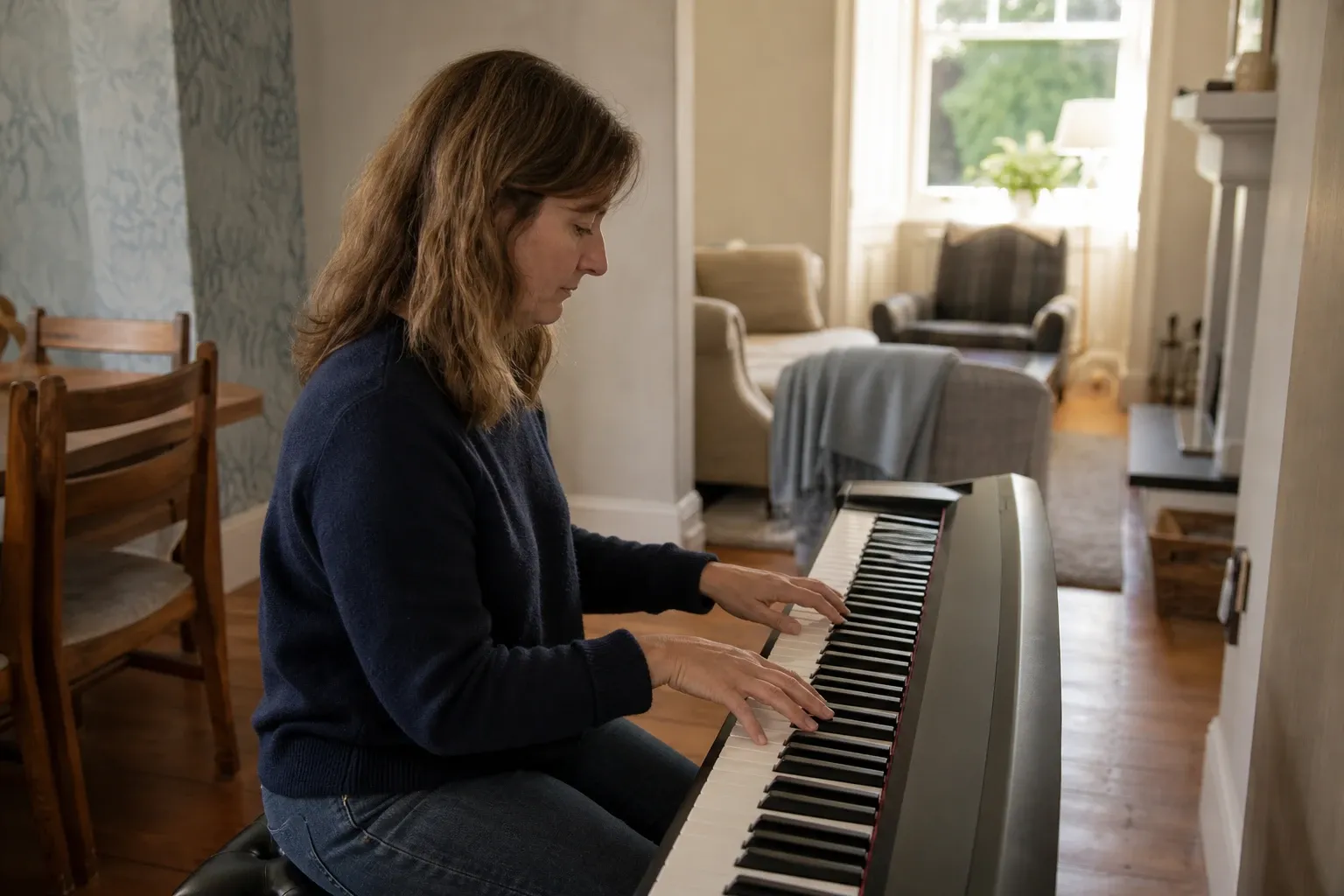
Roughly easiest first:
- Ode to Joy (right hand, five notes)
- Twinkle Twinkle Little Star
- Happy Birthday (a bigger jump in the middle)
- Simple pop songs built on four chords
Chord songs suit play-by-ear learners because once you know a few chords, many songs reuse them. Free tutorials can teach any one of these. If you want a path that keeps building from there, that’s where a structured course earns its cost.
How this fits into learning piano as an adult
Free lessons are one way in, and our adult piano learner overview shows how they fit with courses, books and teachers. If you’re weighing paid options next, the best online piano lessons for adults guide compares them in more depth.
Which should you choose?
Pianoforall is the best pick for most adults ready to move past free lessons, because it offers one set chord-led path, a single $49 payment with no subscription, and offline ebooks.
Choose Piano With Jonny if you prefer a large streamed membership, OnlinePianist if you only want song tutorials, and a live teacher if hand feedback matters most. Start with free videos if you’re unsure; you lose nothing by trying.
When you’re ready for a set path, check Pianoforall’s current price, trial billing and 60-day refund terms on the vendor’s site.
Try or buy Pianoforall on the official site60-day money-back guarantee
Common questions
- Are free piano apps with no subscription any good?
Free piano apps without a subscription can help you learn note names and a few songs. Most hold back their full lesson path for paying members, so expect a sample. Check whether a trial needs card details and when billing begins before you start.
- Do free piano lessons give a certificate?
Most free piano lessons on YouTube and lesson sites don’t offer a certificate. Even many paid self-paced courses don’t state one. If you need a formal record of your level, graded exams with a teacher are the usual route, which is a separate path from self-study.
- Can I learn piano online for free without sheet music?
Yes. Many free video tutorials teach by showing the keys and chord shapes, so you can play without reading sheet music. Learning a few chords and listening for them in songs is a common way to start. Reading music can come later if you want it.