Heads up: some links here are affiliate links. If you buy through one, we may earn a commission; your price stays the same. Details
Pianoforall: A self-paced online piano course that starts with chords and rhythm, with video lessons and downloadable ebooks, for one $49 payment.
Try or buy Pianoforall on the official site60-day money-back guarantee
In this guide (7 sections)
- Can I teach yourself to play piano by ear?
- Before you start: what you need and which songs to pick first
- Step 1 to 3: Find the first note, then the melody
- Step 4 to 6: Add chords and chord progressions
- How long does it take, and what should a weekly routine look like?
- Where beginners get stuck and how to fix it
- Where to go next
Can I teach yourself to play piano by ear?
Yes, you can teach yourself to play piano by ear, and the path is simple: single notes, then melodies, then chords. It’s a skill built by listening and repeating, not a gift you either have or don’t.
What playing by ear actually means
Playing by ear means hearing music and finding it on the keys without sheet music. It rests on ear training (practising how you listen) and on your listening skills, which grow with use.
Quick tip: Try this today. Press any key, hum it back, then press a different key and hum that. You’re already doing the core exercise.
Is perfect pitch required?
Perfect pitch, naming a note with no reference, is rare and you don’t need it. What you need is relative pitch, which means hearing how notes relate to each other, like noticing a tune goes up a bit or down a lot. You can train it.
Playing by ear isn’t a replacement for music theory (the rules behind how music fits together). It’s a different way in, and many people pick up theory more easily once they can hear what it describes.
Before you start: what you need and which songs to pick first
You need a keyboard or piano, a way to replay your song, and a phone to record yourself. That’s all.
Easiest songs and genres to begin with
Choose slow, singable tunes with a narrow range of notes. Nursery rhymes, folk tunes and simple pop songs work well.
- Twinkle Twinkle Little Star
- Happy Birthday
- Ode to Joy
- A slow pop chorus you already sing along to
Songs to save for later
Fast, dense or heavily chorded rock and jazz can wait. Too many notes at once makes it hard to tell what you’re hearing, and that’s when people quit.
Wondering which instrument is easiest? There’s no single answer, but piano is friendly because every note is laid out in front of you.
Step 1 to 3: Find the first note, then the melody
Start with one familiar tune and find its first note, then build outward a few notes at a time. Expect the first short song to take several sessions. That’s normal.
Step 1: Sing or hum the tune and find your starting note
Humming first connects your ear to your hands. Hum the opening, press a key, and ask: is this higher or lower than what I’m humming? Adjust until it matches.
Step 2: Match melody notes to keys using steps and skips
Each new note either repeats, moves a step (to the next key) or skips further. These distances are called intervals. The first two notes of Twinkle Twinkle are a handy skip to remember.
Step 3: Work in small phrases and repeat to memorize
Learn two to four notes, loop them until they feel easy, then join phrases. Trial and error is the method here, not a sign you’re doing it wrong.
Example: for Twinkle Twinkle, find the first phrase (“Twinkle twinkle little star”), play it five times, then move on.
Step 4 to 6: Add chords and chord progressions
Once you can play a short melody, add chords underneath. A chord is several notes played together; a triad has three.
Step 4: Learn a few triad chords
Start with C, F, G and A minor. Use the octave (the same note name, eight white keys up) as a landmark for finding your way around. Our guide to easy piano chords for beginners shows the shapes.
Step 5: Hear when the chord changes
Listen for the bass note, the lowest sound, shifting. Test which of your chords fits. Many pop songs reuse the same few chord progressions (orders of chords), so your ear gets quicker with each song.
Step 6: Play the melody with the chords together
Hold one chord per bar in your left hand while the right hand plays a simple melody. Go slowly. Trust your ears first, then check against a chord chart.
How long does it take, and what should a weekly routine look like?
There’s no fixed timeline for learning piano by ear. Progress depends mostly on how often you practise, and people vary a lot.
A simple 20-minute daily routine
This routine suits absolute beginners and returners alike:
- 5 minutes: listen to two notes and name them as higher, lower or the same, or hum intervals.
- 10 minutes: work on your current song, one phrase at a time.
- 5 minutes: practise a chord or record yourself and listen back.
Set one small goal each week, such as “play the first line of Ode to Joy.” For more structure, see our piano practice routine for beginners.
The 80/20 rule: focus on the skills that matter most
The 80/20 rule is the idea that a few skills give most of the payoff. For playing by ear, those are relative pitch, a handful of common chords and steady rhythm. Spend most of your time there rather than on everything at once.
This is a practical rule of thumb, not a measured result.
Try or buy Pianoforall on the official site60-day money-back guarantee
Pianoforall’s maker describes it as video lessons and ebooks teaching chords and rhythm-style playing, for $49 once. Our button opens its 7-day trial page, where you can buy outright or start the trial (the trial needs payment details and charges $49 when it ends unless you cancel). This is an affiliate link, so we may earn a commission at no extra cost to you.
Where beginners get stuck and how to fix it
Most beginners stall because the task is too big, not because they lack ability. Shrink the task and it usually moves again.
Common mistakes
- Choosing a song that’s too hard
- Attempting a whole song at once
- Not looping short phrases
- Skipping the humming step
- Giving up on chords too soon
Fixes: shrink the section to two notes, slow the recording down, and sing the note before you press it.
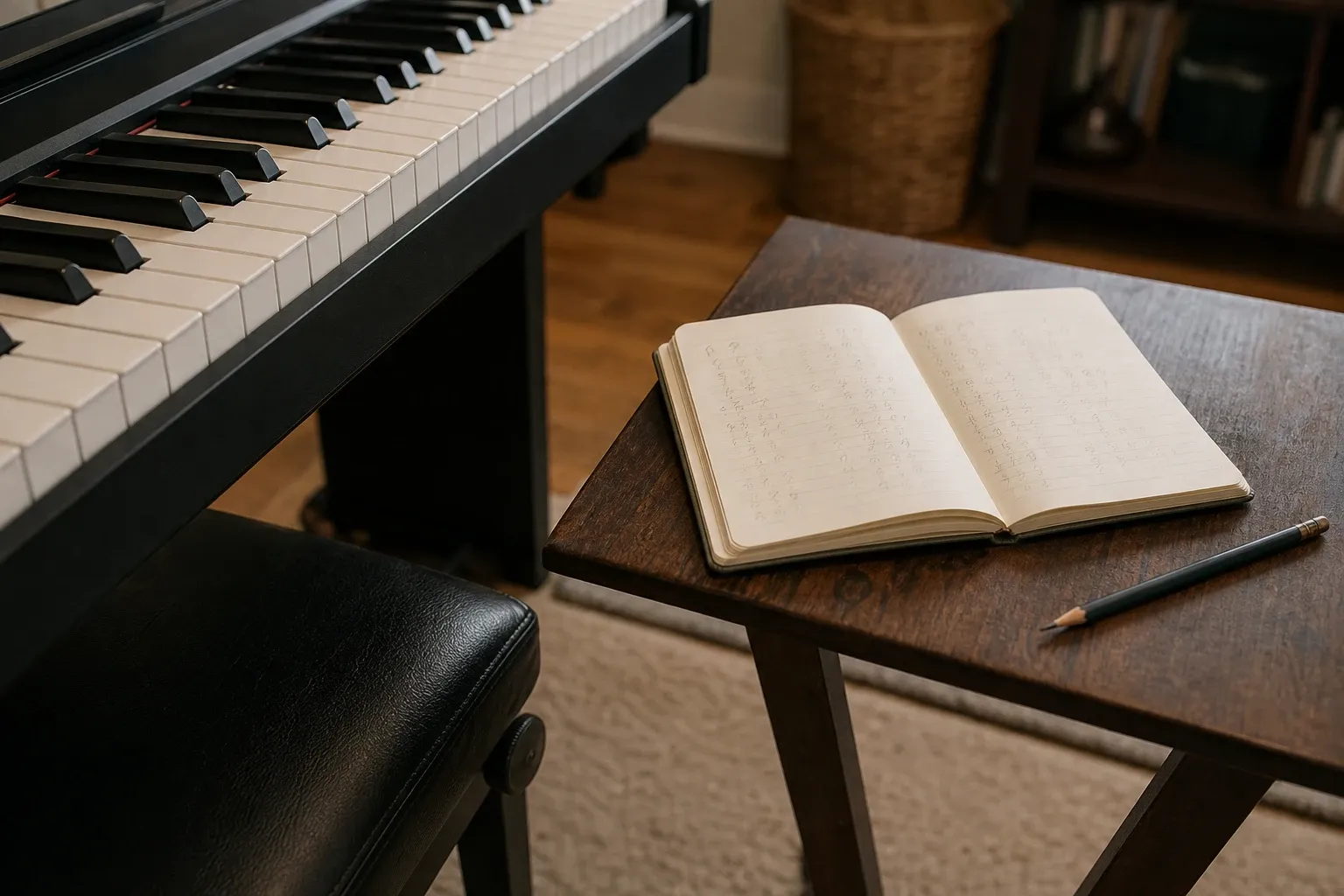
Write down what you find, as note letters or a simple chord chart. It helps you remember and leads gently toward sheet music.
When to use apps, sheet music or a course
Ear-training apps and slow-down players are useful extras. A structured course helps if trial and error starts to feel aimless. The maker says Pianoforall starts with rhythm-style playing and chords, though a course description doesn’t show how any one learner will do.
A course like this doesn’t give individual feedback on your playing, so recording yourself is worth the habit.
Where to go next
Playing by ear is one strand of learning as an adult. Our overview, learning piano as an adult, shows how ear skills sit alongside chords, rhythm and reading.
If you’re weighing a guided course, read our Pianoforall review for what it teaches and who it suits. Otherwise, pick one nursery rhyme tonight and find its first note.
Common questions
- Should I learn to read sheet music as well?
It helps, but you don’t have to start there. Playing by ear gets you making music quickly, and reading can follow later at your own pace. Many learners find notation easier once they already know how the notes sound.
- Can I use apps to learn by ear?
Yes. Ear-training apps can drill intervals and chord sounds, and slow-down players let you loop tricky phrases from a recording. They work best alongside real keyboard time, where you find the notes with your own hands.
- Do I need a teacher to learn by ear?
No, many adults start on their own with short daily sessions. A teacher can give feedback on technique and spot habits you can’t hear yourself. If you go solo, record yourself and listen back to catch wrong notes.