Heads up: some links here are affiliate links. If you buy through one, we may earn a commission; your price stays the same. Details
Pianoforall: A self-paced online piano course that starts with chords and rhythm, with video lessons and downloadable ebooks, for one $49 payment.
Try or buy Pianoforall on the official site60-day money-back guarantee
In this guide (9 sections)
- Start here
- Is it hard to learn piano as an adult?
- The keyboard in five minutes: the 12 keys and middle C
- How do I choose a self-study piano course?
- Can I play piano without learning to read notes?
- Chords, scales and finger exercises: what to practise first
- What is the easiest first song to learn on piano?
- How long does it take to learn piano, and how should I practise?
- Why do piano students quit, and how do I keep going?
Start here
The adult piano learner’s path runs from choosing a course to chords, playing by ear and a steady routine. These guides go deeper on each step:
- How to start learning piano: your first week, step by step.
- Teach yourself how to play the piano: how to study at home without a teacher.
- Best online piano lessons for adults: what to compare before you pay for a course.
- Piano practice routine for beginners: short daily plans you can keep up.
- Pianoforall review: what one chords-first course teaches and who it suits.
Is it hard to learn piano as an adult?
Learning piano as an adult is very doable. It takes patience more than talent. You bring focus, clear reasons to play and the ability to follow an explanation. What takes time is getting your fingers to do what your brain already understands.
There are honest trade-offs too. Adults usually have less free time, judge themselves harder and can get bored with very simple pieces.
How adults learn differently from kids
Adults learn piano by understanding first, while kids often learn by copying and repeating. You can grasp why a chord works in a minute. Your hands still need the same repetition a child’s do.
For example, you might understand a C chord at once but need a few days before your hand lands on it without looking. That gap is normal.
Can a 70-year-old learn piano?
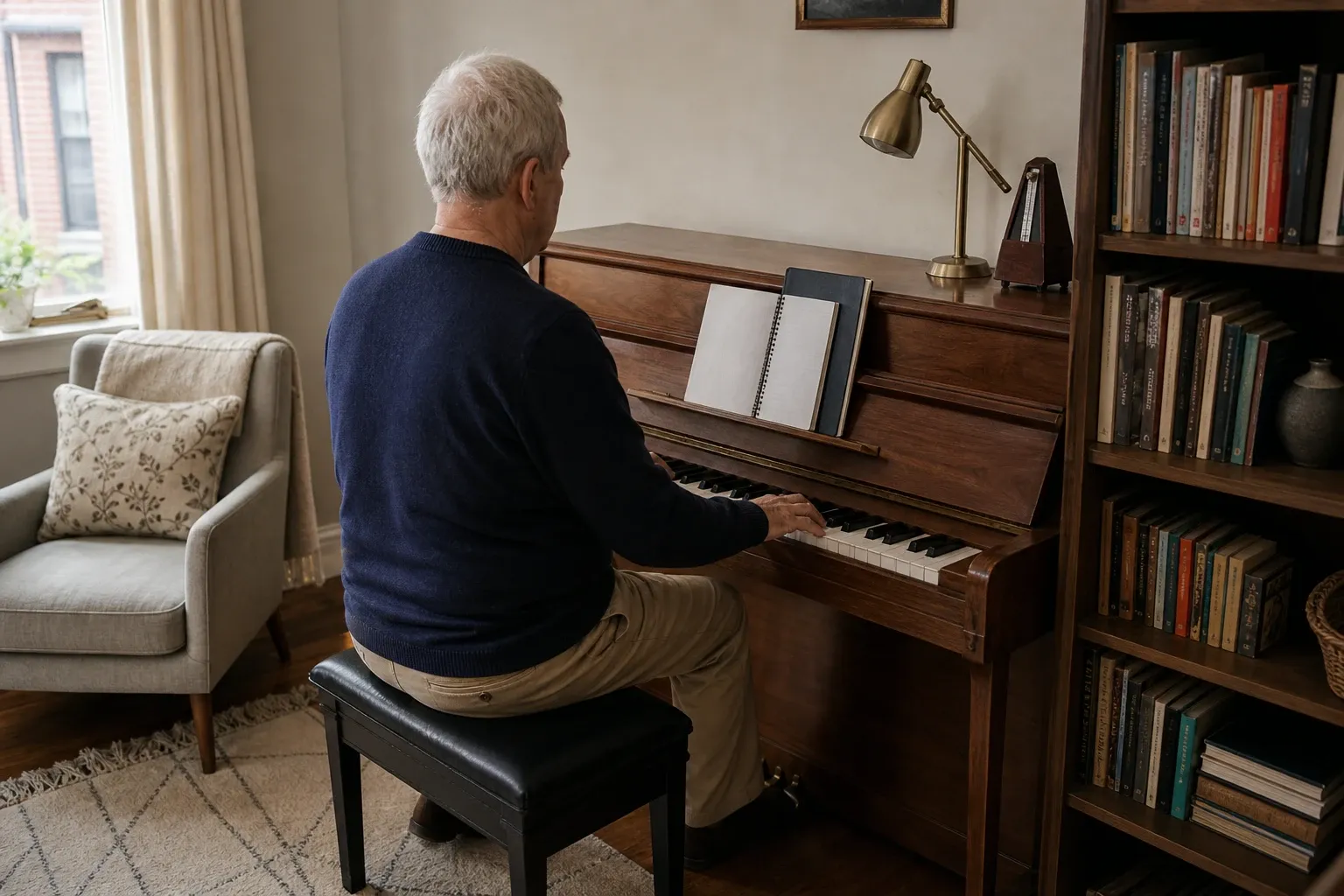
A 70-year-old can learn piano and enjoy it. Go slower, keep sessions short (10 to 15 minutes is fine) and take breaks. If your hands or wrists ache, stop and talk to your doctor before carrying on.
Is 5 too early to start piano lessons?
Age 5 can work for piano if sessions are short and playful, often just a few minutes. This page is for adults, though, so the rest of it sticks to grown-up learners.
The keyboard in five minutes: the 12 keys and middle C
The piano keyboard is one 12-key pattern repeated from left to right: 7 white keys and 5 black keys. Learn that one pattern and you know the whole instrument.
Why the pattern repeats
The pattern repeats because each group of 12 keys covers one octave, which is the distance from one note to the next note with the same name. The white keys are named A to G, then the names start again.
The black keys sit in groups of two and three. C is the white key just left of any group of two. F is the white key just left of any group of three.
Moving to the very next key, black or white, is a half-step. Moving two keys is a whole-step. A sharp (#) means one half-step up, and a flat (b) means one half-step down. So the black key between C and D is both C# and Db.
Finding middle C and an octave
Middle C is the C closest to the middle of the keyboard, usually right in front of you. Play it with your thumb, then count up eight white keys to the next C. That stretch is an octave.
Good posture helps from day one. Sit tall with your forearms about level with the keys and your fingers gently curved, as if resting on a small ball.
Quick tip: Close your eyes and find every C by feeling for the groups of two black keys.
How do I choose a self-study piano course?
The best self-study piano course is the one with a clear order, a teaching style that fits your goals, and lessons you’ll actually open. Compare a few before you commit.
Free lessons or a structured course?
Free lessons are great for trying piano out, but they often jump around. A structured course gives you a set order, so you always know what comes next. A good test is to try free videos for a week or two. If you keep wondering what to learn next, that’s when structure helps.
Online lessons vs a one-on-one teacher
Online lessons suit self-paced home study, and a one-on-one teacher suits people who want someone to check and correct their technique. Video courses can show you good hand shapes, but they can’t watch you play. Some learners mix the two, with a course for daily study and an occasional teacher check.
What to check before you commit
Before you buy beginner piano lessons, check these points:
- Teaching style: notes first (reading music) or chords first (playing songs quickly).
- Pacing: small steps you can repeat.
- Written material: books or charts you can keep open on the music stand.
- Feedback: a community, a teacher or nothing at all.
- Price and billing: paid once or a subscription.
Pianoforall is one example of a chords-first option. The maker describes it as video lessons plus downloadable ebooks that teach rhythm-style playing (steady chord patterns under a song) and chords, then blues, jazz and classical. The maker says students play real music from the start. That’s the maker’s claim, and how fast anyone improves depends on the person.
Can I play piano without learning to read notes?
You can play a lot of piano without reading notes by using chord symbols, letter names and your ear. Plenty of pop, folk and worship songs are played this way.
Chord charts and letter names
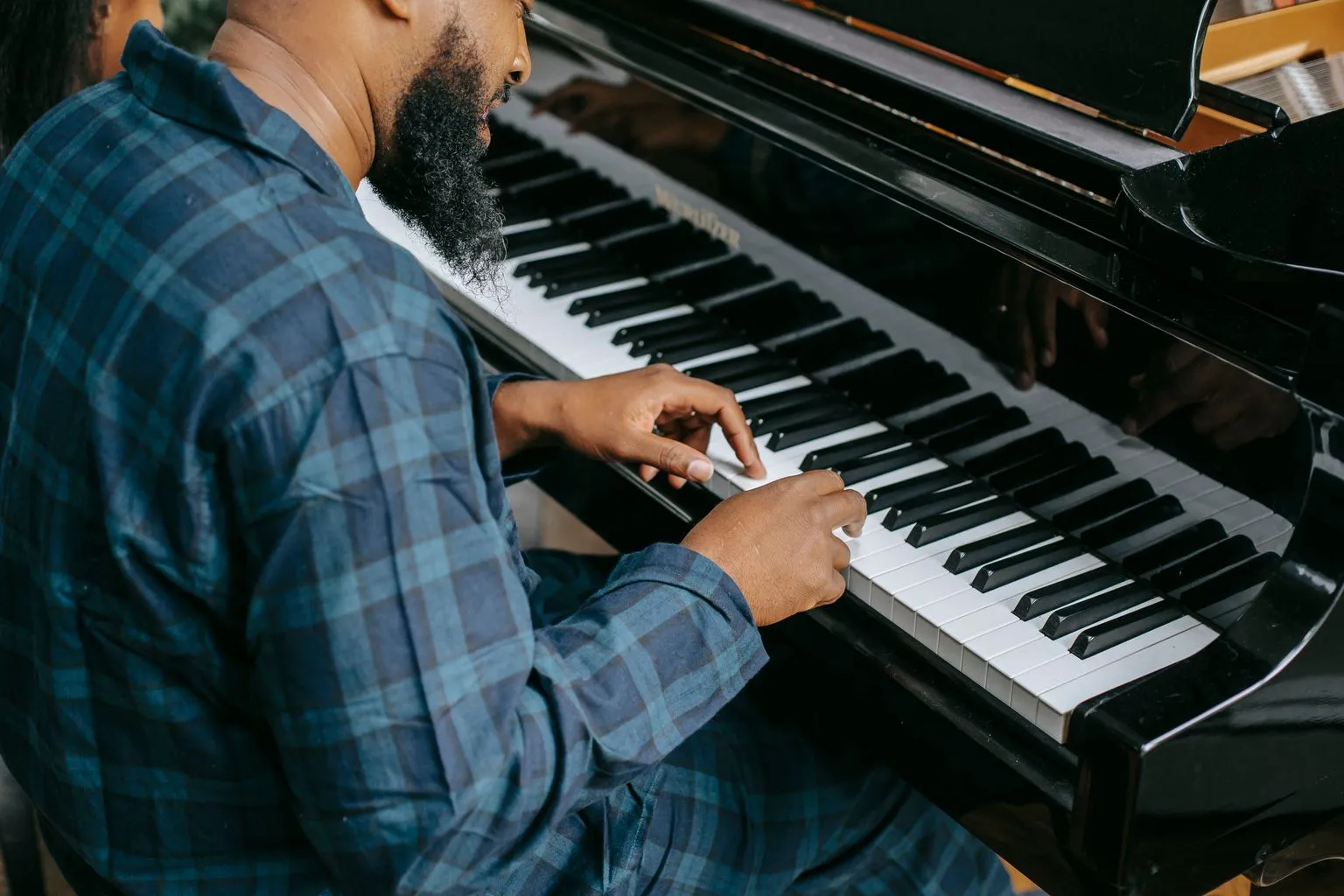
Chord charts show a song’s chords as letters, like C, G, Am and F, written above the lyrics. You hold the chord with one hand, or play its lowest note with the other, and change chords where the chart says. A capital letter alone means a major chord, and a small “m” means minor.
Playing by ear
Playing by ear is a skill you can train, not a gift. Start by learning a few chord shapes. Then listen to a song and find its lowest note (the bass note) and hear when it changes. Try humming a song’s first note, then hunting for it on the keys until it matches.
When reading sheet music is worth adding
Sheet music, the five-line staff with notes, is worth adding when you want classical pieces or exact arrangements. The treble clef usually shows the right hand and the bass clef the left. Sight-reading, which means playing music you haven’t seen before, comes later.
A little music theory makes all of this easier. Scales are ordered runs of notes, and chords are built by stacking notes from a scale. The maker of Pianoforall says its course teaches reading music more easily by learning to play first. That’s the maker’s view of its own approach.
To see how a chords-first course lays out its lessons, look at the course details, the $49 price and the trial billing terms on the vendor’s site.
Try or buy Pianoforall on the official site60-day money-back guarantee
Chords, scales and finger exercises: what to practise first
For most adult beginners, chords come first, with short scales and optional finger exercises alongside. Chords get you playing songs, while scales and drills slowly build control.
Chords first: a few shapes unlock many songs
Three chords, C, F and G, are enough for hundreds of songs. Each one is a triad, or three notes stacked by skipping a white key:
- C major: C, E, G
- F major: F, A, C
- G major: G, B, D
To make a minor chord, move the middle note down a half-step. C, Eb, G is C minor. Notice how it sounds sadder.
Scales and fingering
Scales build fingering, which means knowing which finger plays which key, and they help you get to know each key. In C major, the right hand plays C-D-E with fingers 1-2-3, tucks the thumb under to F, then carries on to C. A couple of minutes a day is plenty.
Finger exercises, Hanon and tempo
Finger exercises such as Hanon exercises are optional practice drills for evenness and strength. If you try them, use a metronome (a clicking beat) at a slow tempo, meaning speed. Something like 60 beats per minute works, and you only speed up once it feels easy.
What is the easiest first song to learn on piano?
The easiest first songs use one hand or three chords at a slow tempo. Ode to Joy and Heart and Soul are common starters. Pick something you like, because that’s what keeps you practising.
Good first songs compared
Good first songs for adults differ by how many hands they need, which chords they use and how fast they go.
| Song | Hands to start | Chords or notes | Tempo | Good for |
|---|---|---|---|---|
| Ode to Joy | Right hand only | Five notes, C to G | Slow | Absolute beginners |
| Heart and Soul | One or two hands | C, Am, F, G loop | Medium | Playing with a friend |
| Amazing Grace | Right hand, then chords | C, F, G | Slow | Returners and older learners |
| Let It Be | Two hands | C, G, Am, F | Slow to medium | Chord learners |
Start with the melody in one hand. Once that’s steady, add one left-hand note or chord on the first beat of each bar. For more ideas, take a look at our list of easy songs.
How long does it take to learn piano, and how should I practise?
Most adults can play a simple song within weeks. Comfortable, varied playing takes months to years, depending on how often you practise and what you want to play. Everyone moves at their own pace, so treat these as rough guides.
A realistic timeline
These are rough ranges, not promises:
- First weeks: find notes and play a one-hand melody or a three-chord song.
- First months: both hands together on simple songs, plus a few more chords.
- A year or more: more styles, smoother changes and maybe some reading.
A manageable weekly routine
A routine of 15 to 30 minutes, five days a week, works well for most adults. Split a 20-minute session like this:
- Five minutes of warm-up, such as a scale or a chord change.
- Ten minutes of new material.
- Five minutes on a song you enjoy.
Short, regular sessions beat one long session a week, much like watering a plant a little each day instead of flooding it once. Keep a simple log with the date, minutes and what you worked on.
Piano or keyboard at home
A keyboard with full-size keys works for home practice. Weighted or touch-sensitive keys feel closer to a real piano. For example, the Pianoforall maker asks for at least 61 full-size touch-sensitive keys and a sustain pedal.
Why do piano students quit, and how do I keep going?
Piano students usually quit because of a missing plan, dull material, expecting to progress too fast, or one busy week turning into a month off. Each of these has a simple fix.
Common stalls
These are the stalls adult learners hit most:
- Not knowing what to practise next.
- Pieces that don’t feel like music you’d actually listen to.
- Feeling slow compared with videos online.
- Missing a few days, then feeling guilty about starting again.
Fixes that work
Small goals and songs you love fix most stalls. Aim for a goal like “switch smoothly from C to G this week.” Practise at the same time each day, such as after your morning coffee. After a break, just restart with an easy song and skip the guilt.
If heavy theory lessons put you off before, a chords-and-rhythm course may suit you better. Pianoforall costs $49 once for the complete course, with no subscription. Our button opens its 7-day trial page, where you can buy outright or start the trial (the trial needs payment details and charges $49 when it ends unless you cancel). Our Pianoforall review covers refunds and who it suits.
Compare the trial and pay-now options side by side on the vendor’s site before you choose.
Try or buy Pianoforall on the official site60-day money-back guarantee
Your best next step costs nothing: find middle C today, play C, F and G, and set a 15-minute slot for tomorrow.
This page may contain affiliate links. If you buy through them, we may earn a commission at no extra cost to you.
Every guide on this site
Getting started
- Your first steps
- Teaching yourself at home
- How hard is piano?
- Learning on a keyboard
- Keyboard layout and note names
Courses and lessons
- Online lessons for adults
- Pianoforall review
- Pianoforall vs other courses
- Best way to learn (quiz)
- Free lessons
- Cheapest ways to learn
- Books for self-study
Chords
- Easy first chords
- Chord chart
- Major, minor and other chords
- Chords in each key
- Chord progressions
- Seventh and jazz chords
Practice and playing
Common questions
- Do I need a teacher to learn piano as an adult?
No, many adults learn at home with a structured course, chord charts and steady practice. A teacher adds something a video can’t: someone watching your hands and correcting technique. Some learners combine self-study with an occasional lesson to check their posture and fingering.
- Can I learn piano with free online lessons?
Yes, free online lessons can teach you the keyboard, basic chords and simple songs. The usual gap is order. Free videos often skip around, so you may need to plan your own path or move to a structured course once you’re unsure what to learn next.
- How much should I practise each day?
Around 15 to 20 minutes most days suits many adult beginners. Split the time between a short warm-up, something new and a song you enjoy. Regular short sessions tend to work better than one long weekly session. Older learners can start with 10 minutes.
- Should I learn chords or sheet music first?
It depends on your goal. Chords first gets you playing pop and folk songs sooner and helps with playing by ear. Sheet music first suits people aiming for classical pieces. Many adults start with chords and add reading later, once playing feels familiar.
- Is a 61-key keyboard enough for a beginner?
A 61-key keyboard covers most beginner songs and chord work. Full-size, touch-sensitive keys feel closer to a piano. Some courses list minimums. Pianoforall, for example, asks for at least 61 full-size touch-sensitive keys and a sustain pedal. Very wide classical pieces need more keys.