Heads up: some links here are affiliate links. If you buy through one, we may earn a commission; your price stays the same. Details
In this guide (10 sections)
- Quick picks
- Which type of piano book should I pick? Quick answers by goal
- Piano book styles compared: pacing, notation, chords and support
- What to check before you buy a teach-yourself piano book
- Can a book alone teach you piano, and who does it suit?
- Building a manageable practice routine with a book
- Book or video course: where Pianoforall fits
- How to choose: a simple decision rule
- How this fits into learning piano as an adult
- Our pick for most readers
Quick picks
Pianoforall is our top pick for most adults who want chords, songs and playing by ear, because it pairs ebooks with video lessons for one payment.
Our top pick: Pianoforall
- Book plus video in one: the maker describes downloadable ebooks with embedded video and audio, plus an online Academy player.
- One clear price: the complete course is a one-time payment of $49, with no subscription.
- Chord-led route: the maker says it starts with rhythm-style playing and chords, then moves into blues, jazz and classical.
Pianoforall is a self-paced course, not live individual tuition. Check the current course, price and trial billing terms on the vendor’s site.
Try or buy Pianoforall on the official site60-day money-back guarantee
- Alfred’s Basic Adult Piano Course, Lesson Book 1: best for a low-cost printed book with a chord approach, ideally with a teacher or experienced musician nearby.
- Faber Adult Piano Adventures All-in-One Course Book 1: best for a printed book that combines lessons, technique and theory with online audio/video support.
This guide uses published course and book information; we have not completed these courses or books.
Which type of piano book should I pick? Quick answers by goal
The right piano book type depends on your goal: reading music, playing songs with chords, playing by ear, or seeing and hearing every example.
We judged each style on five things: pacing (how quickly new ideas arrive), notation focus, chord coverage, audio or video support, and whether the tone suits adults. These are book styles judged on their published format.
Want to read sheet music: notation-first method book
A notation-first method book suits you if reading sheet music is the main goal. It teaches notes on the staff (the five lines music is written on) one at a time, with short pieces after each step. Alfred’s Teach Yourself to Play Piano, from Alfred Music, is a well-known example of this adult method-book style.
Want to play songs with chords: chord and lead-sheet book
A chord book suits you if you want to play songs quickly. A chord is three or more notes played together, and a lead sheet shows just the melody with chord names written above it. Example: play C, then F, then G with your left hand, four slow beats each, while you hum a tune.
Want to play by ear: ear-training or rhythm-style book
A rhythm-style or ear-training book suits you if you want to play songs without reading every note. Playing by ear means working out music by listening. These books teach repeating left-hand patterns you can use under many songs.
Want to see and hear everything: book with video or a video course
A book with video, or a video course, suits you if you learn best by watching hands and hearing examples. Print alone can’t show you what a rhythm should feel like.
Piano book styles compared: pacing, notation, chords and support
Piano book styles differ most in pacing, how much they teach notation versus chords, and whether they include audio or video.
| Book style | Pacing | Notation focus | Chord coverage | Audio or video | Feedback | Best for | May prefer another option |
|---|---|---|---|---|---|---|---|
| Classic method book | Slow, one note at a time | High | Light at first | Varies by edition | None | Careful readers | People who want songs fast |
| Adult-focused method book | Steady, adult pieces | High | Moderate | Varies by edition | None | Adults who want structure | Ear players |
| Chord and songbook | Quick start | Low to moderate | High | Often none | None | Songs and accompaniment | Future classical readers |
| Ear and rhythm-style book | Quick start | Low | High | Sometimes | None | Playing by ear | Strict notation learners |
| Book with online audio or video | Steady | Moderate to high | Moderate | Yes | None | Learners who want to hear examples | People needing correction |
| Video course with ebooks | Self-paced | Varies | Often high | Yes | Varies by course | Visual learners | People wanting a teacher |
Alfred’s Teach Yourself to Play Piano fits the adult method-book row. Check the current edition, format and price on the retailer page, because prices, page counts and included media vary by edition.
Here are the three specific products side by side, with plans and terms as published:
| Course and exact plan | Teaching method | Feedback | Access | Current price | Trial and refund terms |
|---|---|---|---|---|---|
| Pianoforall complete course | Rhythm-style playing, chords, blues, jazz and classical (the maker says) | Self-paced; Piano Lounge community for questions (the maker says); no live individual technique feedback | Online Academy player plus downloadable multimedia ebooks for offline use; lifetime access means while the course continues to be offered and supported by Pianoforall Academy | Complete course, one-time payment: $49 | Pay now, or a seven-day trial requiring payment details, then $49 once unless cancelled before the trial ends. 60 days from payment; request through ClickBank within 60 days of payment |
| Alfred’s Basic Adult Piano Course: Lesson Book 1, item 00-2236 | An adult beginner book using a chord approach | Printed book; publisher says it is most effective with a piano teacher or experienced musician | One printed lesson book | Lesson Book 1: $14.99 (shipping may apply) | 30 days from receipt of shipment, for defective, damaged or wrong items only; replacement, not a general refund. Retailer policies may differ |
| Faber Adult Piano Adventures All-in-One Course Book 1, print edition | Lessons, technique and theory combined | Printed book | One printed book with online audio/video support | All-in-One Course Book 1: $19.99 (shipping may apply) | 30 days for items bought from pianoadventures.com, in original condition; buyer pays return shipping. Other retailers may differ |
What to check before you buy a teach-yourself piano book
A teach-yourself piano book is worth buying when its sample pages match your goal, pace and taste in music.
Pacing and how fast new notes appear
Pacing is how quickly the book adds new ideas. Look at sample pages: if one page adds a new note, a new rhythm and a new hand position all at once, it may feel rushed for absolute beginners. Returners can often handle a faster book.
Notation versus chords
A method book versus a chord book is the biggest choice. Check whether the book teaches left-hand chords and patterns, or only single-note melodies. If you want to play songs, chords should appear in the first few chapters.
Audio tracks and online videos
Audio and video support lets you hear how a piece should sound. Confirm that access is included with your edition and that the online files still work, since older or second-hand copies may lose them.
Adult tone and song choice
Adult beginners usually stay keener with familiar styles like pop, blues or well-known classical tunes rather than children’s songs. Flip through the song list before buying.
Quick tip: Before you buy, play the first exercise on a sample page. If it feels clear, the book’s pace probably suits you.
If you want chords and video in one place, see what the course includes and how its trial is billed on the vendor’s site.
Try or buy Pianoforall on the official site60-day money-back guarantee
Can a book alone teach you piano, and who does it suit?
A piano book alone can teach you notes, chords and songs, but it can’t see your hands or correct mistakes.
There’s no fixed timeline for progress. Your pace depends on your practice, your goal and what you already know. For a fuller picture, see our guide to teach yourself how to play the piano.
Who books suit well
Books suit self-motivated readers who like a fixed order and a low cost. They also suit players of other instruments who already read music and want a clear piano path. Example: a guitarist who knows chord names can work through a chord book quickly.
Who may want video or a teacher instead
Books can’t show hand position, posture or the feel of a rhythm. If you want someone to watch you and correct you, a teacher or live online lessons fit better. Our roundup of the best online piano lessons for adults covers those options.
Building a manageable practice routine with a book
A manageable practice routine with a piano book uses short, regular sessions, often 15 to 20 minutes, sized to fit your own schedule.
Split each session into three parts:
- Review (about 5 minutes): replay yesterday’s page.
- New page (about 10 minutes): learn one new idea slowly.
- A song you enjoy (about 5 minutes): end on something fun.
Track pages and songs rather than minutes. A note like “Page 14, left-hand C chord steady” tells you more than “practised 20 minutes”.
Add chords early, even in a notation-first book. Example exercise: hold C major (C, E, G) for four beats, then F major (F, A, C) for four, then back. Repeat slowly until the change feels smooth. That alone lets you strum along to many simple songs.
Quick tip: Leave the book open on the stand. Starting is easier when the page is already waiting.
Book or video course: where Pianoforall fits
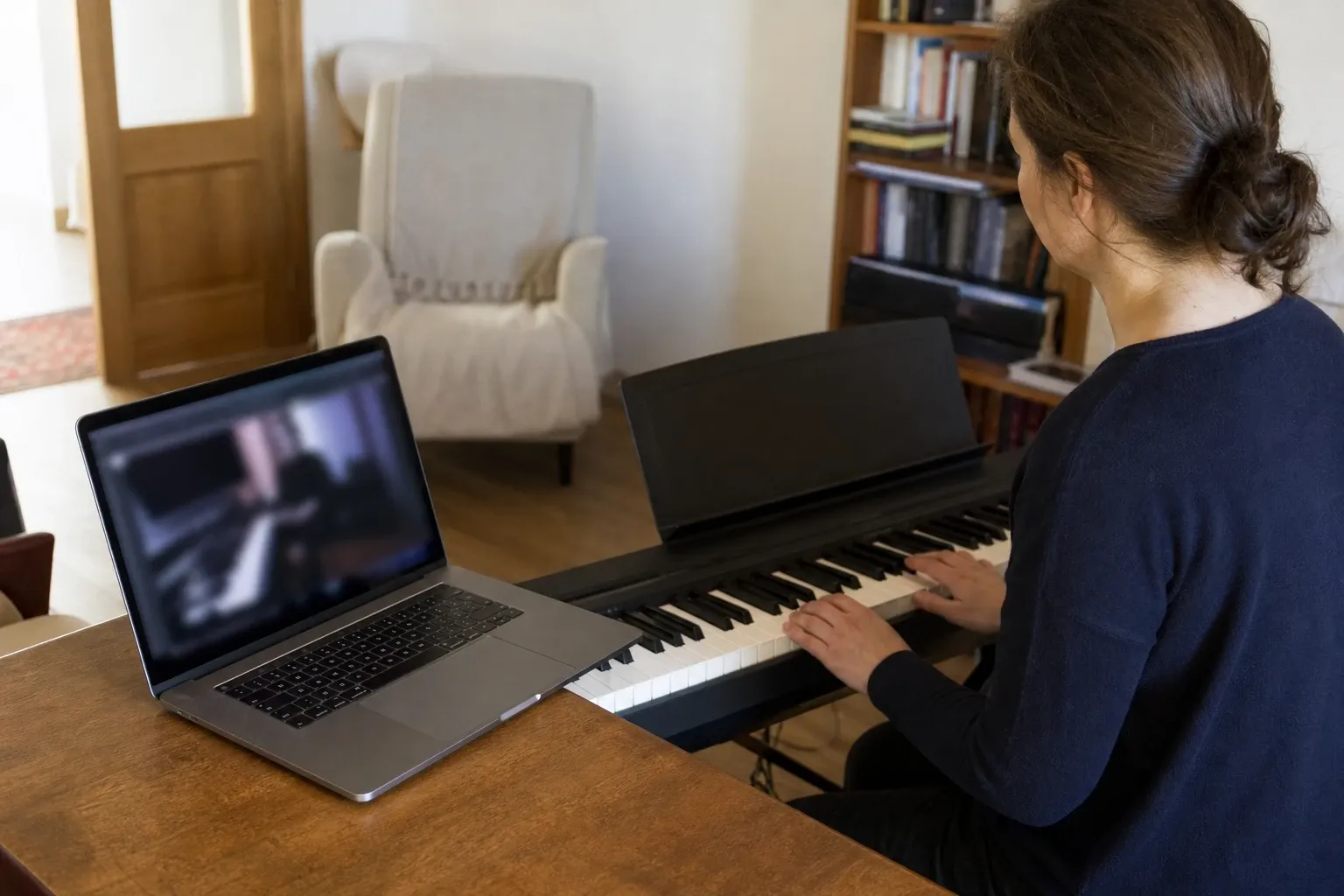
Pianoforall is an online beginner course that sits between a book and a video course, pairing downloadable ebooks with video lessons.
What Pianoforall includes
The maker describes an online Academy player plus ebooks with embedded video and audio for offline use. The maker says it covers:
- A rhythm-style piano book with 15 popular rhythms, ballads and chord progressions
- Jazz piano: runs, riffs, chords, patterns and blues scales
- Advanced blues piano and improvising over blues rhythms
- Classical pieces, reading sheet music alongside playing by ear
- Access to The Piano Lounge community for questions and chatting with students
You’ll need at least 61 full-size touch-sensitive keys and a sustain pedal. The instrument doesn’t need to connect to the course.
Who it suits and who should skip it
Pianoforall suits adult beginners and returners who want a chord-and-by-ear route with video alongside text. It could also help people who want to teach with a chord-led structure.
Who it’s not for:
- Learners who want strictly notation-first study from page one
- Anyone who needs a teacher to watch their hands and give individual technique feedback; a self-paced course can’t do that
Price, payment period and refund terms
The complete course is a one-time payment of $49, with no subscription. You can pay now, or start a separate seven-day trial that requires payment details and then charges $49 once unless you cancel through ClickBank before the trial ends.
The vendor advertises a 60-day money back guarantee: you request it through ClickBank within 60 days of payment. Buy only from the official site so these terms apply. Results are not guaranteed. Our Pianoforall review goes deeper.
Compare the pay-now price and trial billing on the official page before you decide.
Try or buy Pianoforall on the official site60-day money-back guarantee
How to choose: a simple decision rule
The simplest way to choose a piano book or course is to match it to one goal, then stick with it.
- Goal is reading music: a notation-first method book.
- Goal is songs and chords: a chord book or a chord-based course.
- Need to see hands and hear examples: a video course or book with video.
- Need correction: a teacher.
- Then: buy one resource, use it consistently for several weeks, and reassess.
Example: if you mostly want to play pop songs for friends, pick the chord route and skip the classic method book for now.
How this fits into learning piano as an adult
Choosing a book is one step in a bigger plan that also covers your instrument, practice and goals. Our practical overview for the adult piano learner pulls those pieces together. If you’re still weighing books against apps, courses and teachers, our comparison of the best way to learn piano lines up each route side by side.
Our pick for most readers
Pianoforall is the best pick for most readers here because it combines ebooks and video lessons, a chord-led method, offline access and one $49 payment with a 60-day refund window requested through ClickBank.
If you want a cheap printed book for reading notation, the Faber or Alfred adult books are the better match, and if you need correction, a teacher is the right choice. Ready to look? See the current Pianoforall course, price and trial billing terms on the vendor’s site.
Try or buy Pianoforall on the official site60-day money-back guarantee
Common questions
- Is Alfred's Teach Yourself to Play Piano good for adults?
Alfred’s Teach Yourself to Play Piano is written for adult self-learners and follows a method-book style focused on reading notes. It suits adults who like a fixed order. Check the current edition, included audio and price on the retailer page, since formats vary between editions.
- Do I need to read sheet music to start learning piano?
No. You can start with chords and lead sheets, which show the melody with chord names above it, or with rhythm patterns you learn by ear. Reading sheet music helps for classical pieces, but many adults add it later once they can already play a few songs.
- Which teach-yourself piano options include audio or video?
Faber Adult Piano Adventures All-in-One Course Book 1 has online audio and video support, according to its publisher. Pianoforall pairs downloadable ebooks with embedded video and audio. For other books, check the edition details, because included media differ and older copies may lose online access.